Old Bridge Roofing has handled roofing in Aberdeen for more than 20 years, and the bayfront part of the township raises a question most roof jobs never do: where does this house sit relative to the water? Before we talk shingles or underlayment, we want to know whether the property falls in a mapped flood hazard area and whether the house has been raised, because both change how the job is staged and scoped.
Our first visit is about the water that is already getting in. On a leak call we look in the attic as well as on the roof, so the source is traced to the point where it actually enters before anything is priced. If a repair will do the job, we say so plainly, and replacement only comes up when a repair honestly will not.
When a replacement is the right call, the written scope breaks tear-off, decking, underlayment, flashing, ventilation and gutters into separate lines, so an owner can set two estimates side by side and compare them item by item. Our contracts follow New Jersey’s home improvement rules, including the three-day cancellation notice, so nothing about the paperwork comes as a surprise later.
Aberdeen’s Raritan Bay Shore and the Cliffwood Beach Section
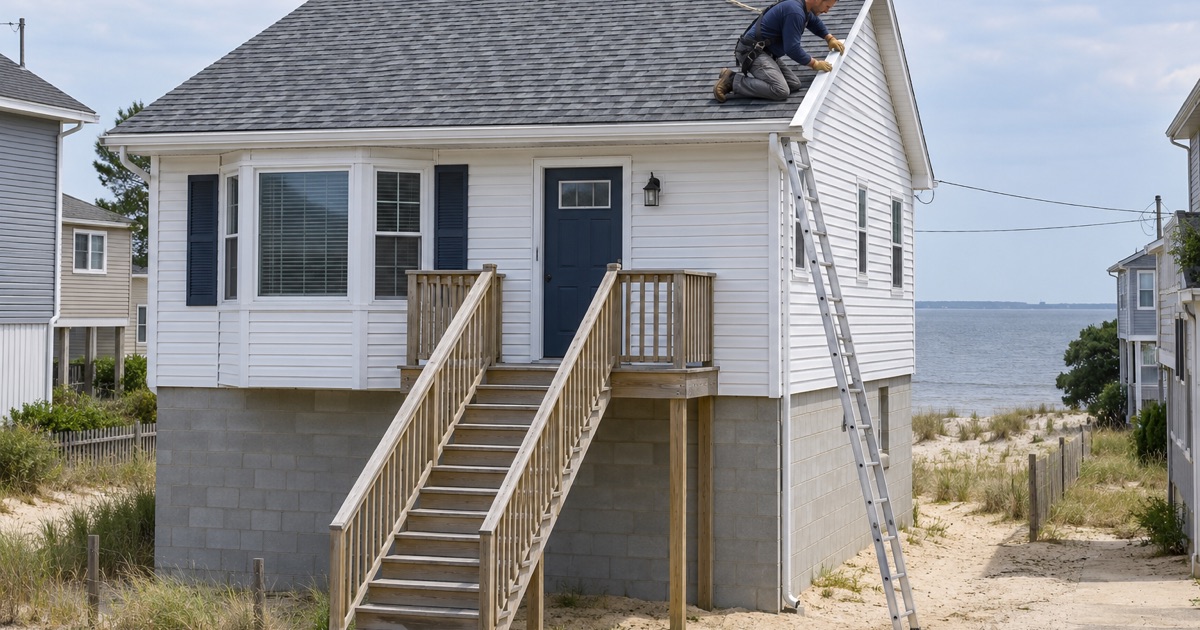
Aberdeen Township, in Monmouth County, has about two miles of shoreline on Raritan Bay, according to the township’s own January 2013 recovery planning report. Close to a third of its 7.77 square miles is water. Much of the township sits away from that shore, but the houses along the bay and along Matawan Creek deal with conditions the inland streets never see.
A Shore That Began as a 1923 Summer Resort
Cliffwood Beach began in 1923 as a resort community of summer bungalows created by Morrisey and Walker. A boardwalk followed in 1924 and a saltwater pool in 1929. Hurricanes between 1954 and 1960 took the boardwalk, Hurricane Donna destroyed the beachfront facilities in September 1960, and a seawall was built in the 1970s.
We do not read much into a Cliffwood Beach house from that resort start. A house on these streets may date from any point in the century since, so its framing, attic and layers of roofing have to be judged on the house itself. Our first look in the attic tells us more about the roof’s history than the neighborhood’s story does.
Township-wide, the Census Bureau’s 2024 five-year survey counts 674 of Aberdeen’s 8,219 housing units as built in 1939 or earlier. On any house built before 1978, painted trim and fascia disturbed during a roof job fall under the EPA’s RRP lead-safe rule, so we confirm the build date before we plan how the fascia and rake boards will be handled.
Matawan Creek and the Wind Off the Bay
Matawan Creek is the other waterfront the 2013 report names, and it singles out properties with dock access to the creek as significantly impacted by the storm. On creekside lots we check how close the house stands to the bank and where the ground is firm before we decide where staging, ladders and the dumpster can go.
On bayfront houses we plan staging and fastening for the wind off Raritan Bay. Aberdeen falls in National Weather Service forecast zone NJZ013, Western Monmouth, issued by the Mount Holly office, and we check that forecast before a tear-off so a deck is never left open with weather on the way. On an exposed lot, shingles rated ASTM D3161 Class F or ASTM D7158 Class H for wind are worth a conversation.
Looking for roofing closer to South Amboy? See South Amboy Roofing.
What Sandy’s Surge Did to the Bayfront in 2012
Hurricane Sandy reached Aberdeen on October 29, 2012. The township’s Strategic Recovery Planning Report, prepared by T&M Associates and issued in January 2013, says the storm brought damage from both storm surge and wind. On the bayfront the surge cut the dunes from ten feet in height to two.
Cliffwood Cut Off by the Water
Flooding isolated significant portions of the Cliffwood section, according to the report, around Lakeshore Drive, Amboy Avenue and Route 35. Sewage pump stations on Lakeshore Drive and on Beach Drive were destroyed. Across the township, trees and power lines came down and outages lasted more than seven days.
Where the Damaged Houses Were
The report counts 26 dwelling units in the township classified as substantially damaged, and says most of those properties were in the Cliffwood Beach area and along Matawan Creek. The report also calls damage to private property minimal compared to other New Jersey municipalities.
The township’s tax-assessment codes for affected properties keep flooding damage, from basement water through significant first-floor water, apart from structural damage, which runs from minimal to total. The report does not say how much of any repair bill was roof work, and we do not assume it. We judge each house as it stands today, starting in the attic.
Elevation Money and What It Does Not Tell Us
Aberdeen received a $900,000 Community Development Block Grant award for homeowner reconstruction, rehabilitation, elevation and mitigation, the program known as RREM, plus $200,000 for homeowner resettlement. The report gives no count of houses actually raised, and we have found none elsewhere. So we never assume a Cliffwood Beach house has been elevated; we ask the owner and look at the foundation.
Roof Work on a House in a Mapped Flood Hazard Area
Aberdeen’s flood damage prevention provisions, as the 2013 report describes them, require compliance with FEMA construction requirements for projects located in FEMA flood hazard areas. That is the township’s own rule, not a general warning about living in a flood zone, and it is why our estimate for a bayfront house begins with the flood map before it ever gets to shingles.
Start With the Lot, Then the Roof
The first questions are about the property rather than the roof: which flood zone the lot is mapped in, and whether the house has already been raised. Coastal maps carry designations such as zone AE and the coastal high hazard zone VE. We read the map for the specific lot instead of guessing from the street, and we ask the owner for any elevation certificate or flood policy paperwork they hold.
Who Decides What a Job Counts As
Whether a particular roof job on a Cliffwood Beach house has any bearing on the township’s floodplain rules is a question for Aberdeen’s floodplain administrator, not for a roofing crew. We do not tell an owner that a new roof will or will not trigger anything. When a project reaches beyond the roof itself, we suggest putting the question to the township before work is scheduled.
What Stays the Same Near the Water
Replacing the roof covering on a detached one- or two-family house is ordinary maintenance under N.J.A.C. 5:23-2.7 and needs no construction permit in New Jersey, whether the house faces the bay or not. What changes near the water is the planning around the work: where material can be staged, how long the deck can safely stay open, and how the new roof is fastened.
Under New Jersey’s rehabilitation subcode, a roof that already carries two or more layers, or a covering of slate, wood shake or tile, is torn off rather than covered over. The 2013 report notes that new housing in the township has trended toward townhomes, condominiums and multi-family buildings, so in an association community we check the governing documents for who holds the roof before writing any estimate.
Raised Houses, Taller Staging and the Roof Above the Flood
A house that has been raised carries its roof higher off the ground than before, and that changes the job before a single shingle comes off. A ladder that reaches an ordinary two-story eave may fall short here, and every bundle going up and every load of debris coming down travels farther.
Staging and Fall Protection
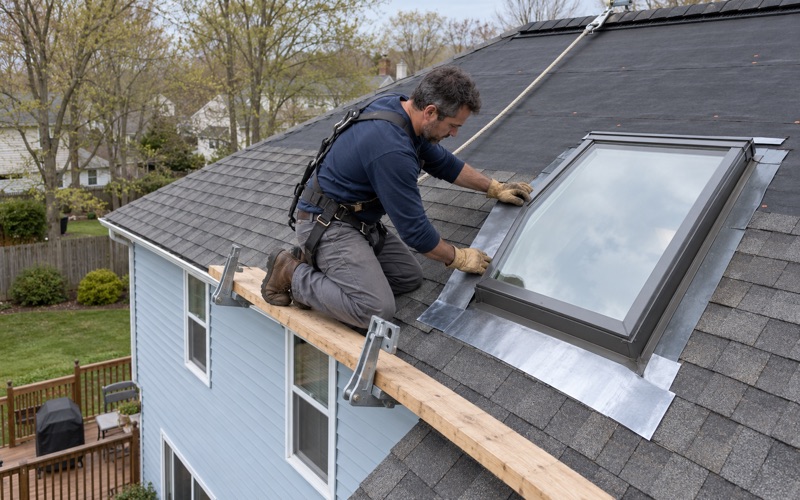
On a raised bayfront house we set staging to the actual eave height and to the ground beneath it, which near the water can be soft or tight against a neighbor’s lot. OSHA requires fall protection at 6 feet for residential roofing under 29 CFR 1926.501(b)(13), and on a house standing on a tall foundation the crew reaches that height well before the roof.
Flashing, Ventilation and Wind Details
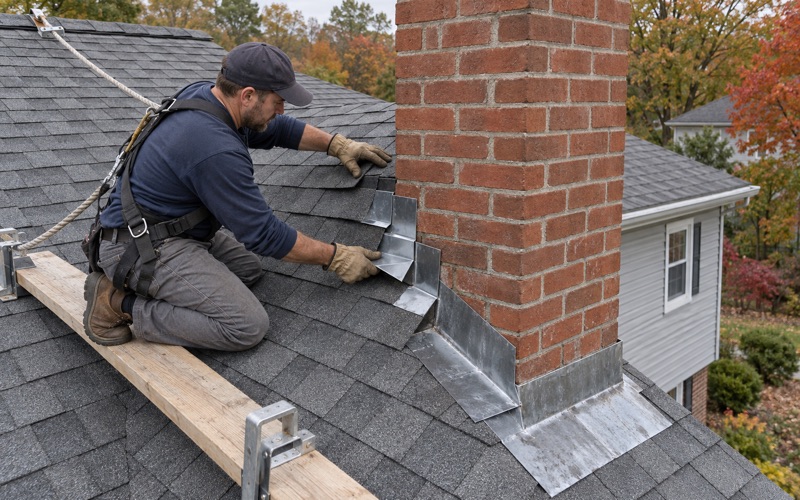
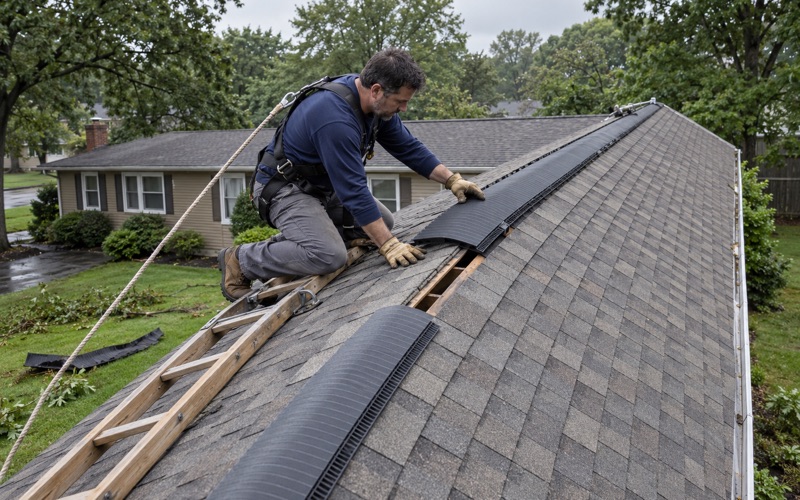
Step, counter and chimney flashing is replaced along with the roof rather than reused under new material, and drip edge goes on at the eaves and rakes. Attic ventilation is checked on every replacement, because a roof that cannot breathe ages from underneath. Where the house allows it, we pair ridge vent with soffit intake and run ASTM D1970 self-adhering ice and water barrier at the eaves and valleys.
For the covering itself, architectural laminated shingles such as GAF Timberline HDZ, Owens Corning Duration or CertainTeed Landmark are the usual choice, and standing seam metal is an option owners on exposed lots sometimes ask about. We lay out the choices and their wind ratings in writing, so the decision is made on paper and not on the roof.
Decking, Gutters and the Finish
If the old roof comes off over damaged decking, we photograph it and show the owner before any of it is replaced, at a per-sheet price already written into the contract. Gutters and leaders are sized and pitched with the roof so water leaves the house rather than collecting at the foundation, and on a raised house that water has farther to fall and needs a clear place to land.
At the end of each work day the driveway, yard and gutters are cleaned, with a magnet sweep for roofing nails. When a storm has already done damage, we photograph it and write it up for the owner’s own claim, and we will meet the insurance adjuster on site if asked. Solar panels on the roof are scheduled for removal and reinstallation as part of the plan, not discovered on the day.
When a bayfront house is going on the market, we write a roof condition report the seller can hand to the buyer’s inspector. On a house near the water, a buyer is likely to ask about the roof alongside the flood map, and a dated written report answers the roof half of that question plainly.
- 20+ Years in Business
- Attic Checked on Every Leak
- Itemized Written Scopes