Old Bridge Roofing brings more than 20 years in the trade to roofing in Bordentown Township, and this page covers the township’s biggest roofs: the low-slope decks over warehouse and distribution buildings. These roofs are measured in acres rather than squares, and a problem on one rarely stays small for long. We approach them the way we approach any roof, starting with where the water actually goes.
On a leak call, that means looking at the underside of the deck from inside the building as well as walking the membrane on top, because water on a flat roof often travels before it drips. Only once the entry point is found do we price anything, and we say plainly whether a repair will hold before a replacement comes up at all.
When replacement is the right call, our written scope breaks the job into separate lines for tear-off, deck repair, insulation and membrane, flashing at walls and curbs, and drainage, so a facility manager can set our number beside another bid and compare it item by item.
Bordentown Township’s Exit 7 Warehouse Corridor
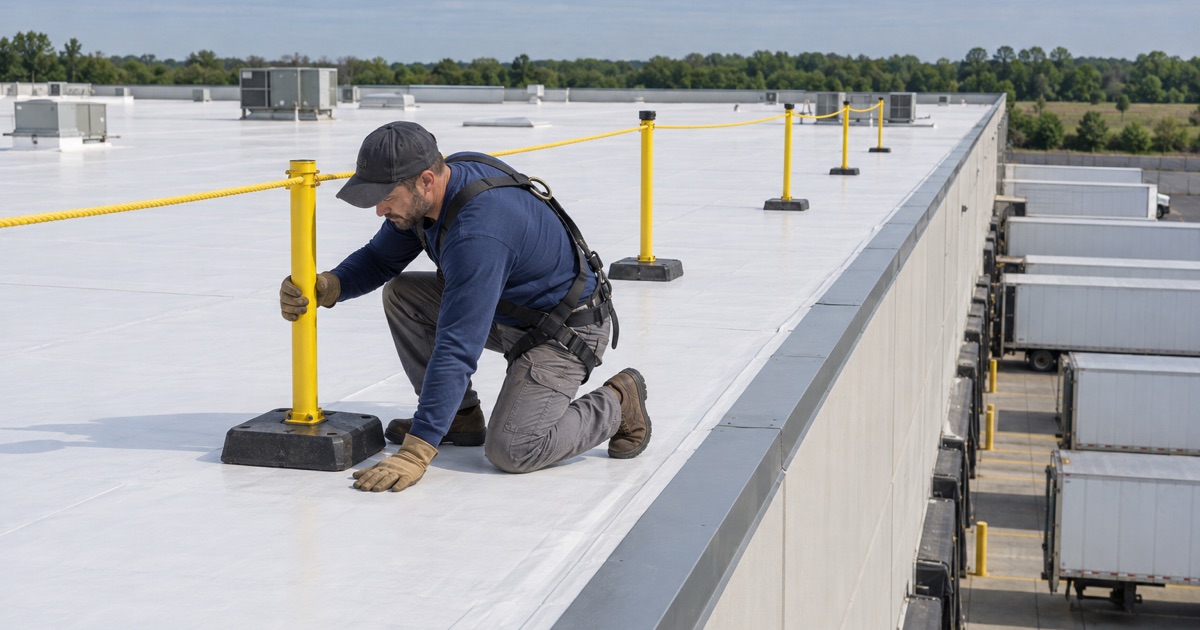
Bordentown Township sits where the New Jersey Turnpike meets US 206 at Exit 7 and where I-295 meets US 130 at Exit 57, with Routes 130 and 206 running through. That crossroads has drawn a run of large distribution buildings, many of them along Rising Sun Road and the Route 130 corridor.
Big footprints, flat roofs
A warehouse near Exit 7 is a wide box with a roof to match. One warehouse near the interchange, at 275,631 square feet, sold for $60 million in 2022, according to Newmark. The others named on this page run from about 180,000 to nearly 274,000 square feet. Buildings of this kind carry large low-slope roofs, and that changes how they are inspected and repaired.
On a pitched house roof, gravity carries water off in seconds. On a low-slope warehouse roof, water moves slowly toward interior drains or edge scuppers, and anything that slows it further, from a sag in the deck to a low spot around a rooftop unit, leaves water sitting on the membrane. Ponding is the condition we look for first, because standing water finds every weak seam.
Where leaks start on a warehouse roof
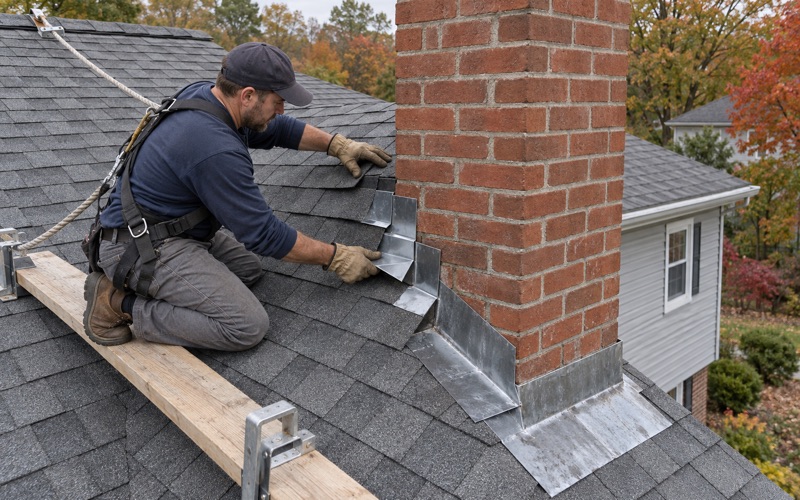
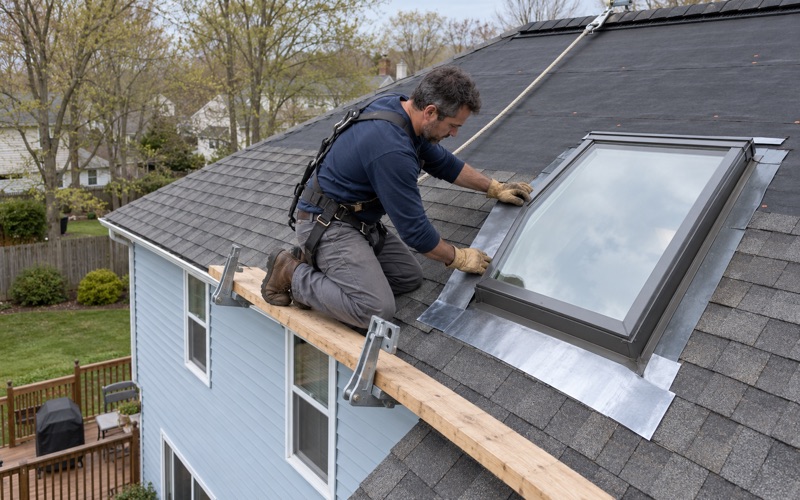
Warehouse leaks tend to begin at an edge or an opening rather than in the open field of the membrane. Roof drains, curbs around rooftop units, skylights and smoke hatches, and the flashing where the roof meets a parapet wall all concentrate stress in a small area. Those details get our closest look on every inspection.
That is why the stain on the warehouse floor is rarely directly below the hole. We work from both sides, marking the drip location inside and then reading the roof above it for the path the water took. A repair placed over the drip instead of the entry point is money spent twice.
Roof drains deserve their own mention. On a roof this size, a single blocked drain can leave a wide pond that adds weight to the deck and keeps the membrane wet for days after the rain stops. Clearing strainers and checking that each drain bowl is tight to the membrane is cheap work that prevents expensive leaks.
Looking for roofing closer to Red Bank? See Roofing Services in Red Bank.
From a 1988 Business Park to 2020s Distribution Buildings
The corridor is useful to understand because its buildings were not all put up at once. Three named projects span more than three decades, and the roofs on them sit at very different points in their lives.
For anyone responsible for a corridor building, the build date on a listing is a starting clue rather than an answer. It points to the right questions about the roof: whether it has ever been replaced, what layers sit under the surface, and whether any warranty paperwork survives.
Interchange 7 Business Park, built in 1988
Interchange 7 Business Park at 320 Rising Sun Road lists 273,842 square feet and a 1988 build date. Listings for the property do not state its roof type, and no source we found says whether the roof on it today is the one it was built with or a later replacement.
That uncertainty is exactly why a building from that era deserves a core cut and a close inspection rather than an assumption. A low-slope roof installed in the late 1980s would be far along in, or beyond, the service life usually expected of a membrane, while a replacement from a later decade could have years left. The only way to know is to cut a small sample and read the layers.
445 Rising Sun Road and Bordentown Crossroads
At the other end of the timeline, ROI-NJ reported in December 2021 that First Industrial had bought a 20-acre parcel at 445 Rising Sun Road for a speculative building: about 208,000 square feet of warehouse space plus 2,950 square feet of office, 36-foot clear heights and 42 dock doors. Delivery was slated for late 2022.
Bordentown Crossroads, a rear-load distribution center of about 179,800 square feet at 1 Bordentown Bypass, was planned by Hillwood with WDG Logistics, with 30 dock doors and the same 36-foot clear height. Construction was set for summer 2024, with completion anticipated in spring 2025. No source we found confirms when either building was actually finished.
If those buildings went up on schedule, their roofs are only a few years old. A low-slope roof that young often carries a manufacturer’s warranty, and where one exists it changes the first step on a leak: the terms usually say who may open the membrane, so we ask to see them before touching it.
Low-Slope Roofs at Both Ends of Their Service Life
A young warehouse roof and an old one call for very different work, and much of our job on a commercial building is deciding which kind of work it actually needs. The question is the same one we ask on any house: can this roof be repaired and kept in service, or has it reached the point where repairs only delay the inevitable?
Early in a roof’s life
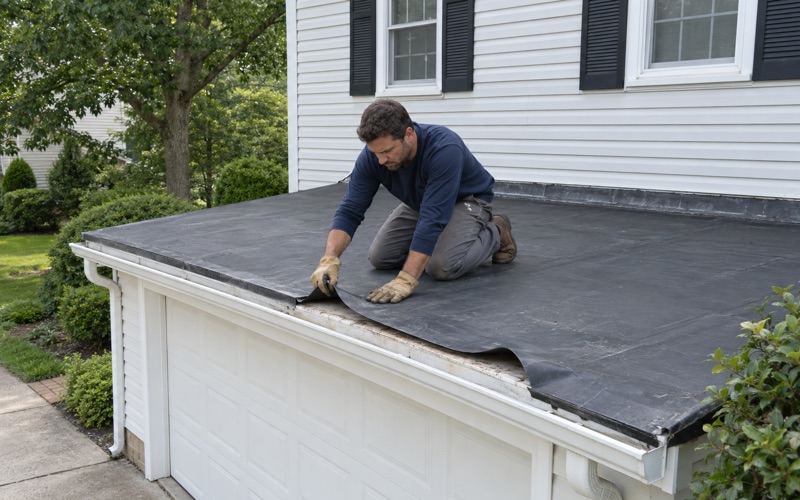
On a roof that is a few years old, the work is mostly maintenance and small repairs. Seams on single-ply membranes such as TPO and EPDM are checked, flashing at curbs and edges is inspected, and any punctures from foot traffic around rooftop equipment are patched. Catching a small cut at this stage costs far less than the wet insulation it would otherwise cause.
We also watch for problems that show up early on new construction, such as flashing that was never fully sealed around a curb or a drain set slightly high so water ponds around it. Photographs of them taken while the roof is young are the owner’s best evidence if a warranty question comes up later.
Late in a roof’s life
On an older roof, the decision turns on what is under the surface. Wet insulation, blistered or shrinking membrane, and seams that open faster than they can be repaired all point toward replacement. An infrared or moisture survey can map wet areas across a large roof, and core cuts confirm what the survey suggests.
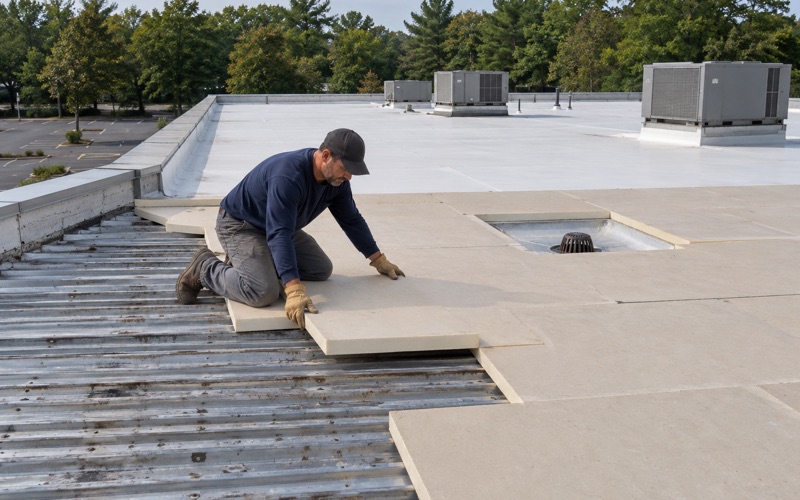
When a tear-off does go ahead, the steel or wood deck underneath is exposed for the first time in years. Any damaged deck we find is photographed and shown to the owner before it is replaced, at a unit price written into the contract, so a hidden condition never becomes an open-ended charge. Flashing at walls, curbs and penetrations is replaced along with the membrane rather than reused.
A re-roof is also the one chance to change what sits beneath the membrane. Adding insulation, tapering it to move water toward drains, and correcting low spots that ponded on the old roof are all easier with the deck exposed, and each is written as its own line in the scope so the owner can see what it costs.
Permit Work and Roofing Over Active Loading Docks
Why a warehouse re-roof needs a construction permit
In New Jersey, replacing the roof covering on a detached one- or two-family house is ordinary maintenance under N.J.A.C. 5:23-2.7, and no permit is needed. That rule covers only those houses. A warehouse is not a one- or two-family dwelling, so re-roofing one falls outside it and is construction-permit work.
In practice, that adds time to the front of a commercial job, and we build it into the schedule from the start rather than discovering it once material is on order. It is one more reason a warehouse re-roof is planned months ahead, not weeks.
Working above dock doors and a running operation
A distribution building rarely shuts down for a roof. With 30 or 42 dock doors planned on the newer buildings, a busy site can have trucks backing in all day, and the floor under the roof is full of racking, product and people. The roof work has to fit around that rather than the other way around.
We stage material and lifts away from the truck courts where we can, and we schedule the sections of roof above the dock doors around the building’s busiest shifts. Tear-off is done only in areas that can be dried in the same day, so an afternoon storm never finds open deck over inventory.
Interior protection matters just as much. Where the deck is opened over stored goods, we coordinate with the facility team to clear or cover the area below, and the site is cleaned at the end of every shift, including a magnet sweep of the truck court and parking areas for loose fasteners that could otherwise end up in a trailer tire.
Storms and documentation
Bordentown Township falls in the National Weather Service’s Northwestern Burlington forecast zone, served by the Mount Holly office, and a roof this large catches every storm that crosses that zone. After a storm, we photograph damage across the roof and write it up for the owner’s own insurance claim, and we will meet the adjuster on site when asked.
Large roofs also hide storm damage well. Lifted edge metal, displaced coping and punctures from blown debris can sit unnoticed for weeks while water works into the insulation, so a walk-through after a major storm is worth scheduling even when nothing is dripping inside yet.
- 20+ Years in Business
- Attic Checked on Every Leak
- Itemized Written Scopes