
Old Bridge Roofing handles chimney repair in Old Bridge, NJ, serving surrounding cities including South River, Aberdeen, South Amboy, Holmdel and Highland Park, and our more than 20 years of roofing have shown us that chimneys are the most common leak source on an otherwise sound roof. A chimney is a masonry box sticking through the roof, and every joint where the two meet has to be sealed against water. When one of those joints fails, the stain usually shows up on the ceiling or wall beside it.
We start every chimney leak call in the attic, looking at the framing and decking around the chimney for water marks. Then we check the flashing, crown, cap and mortar from the roof. That tells us whether the water is getting past the flashing or soaking through the masonry itself.
Our chimney work covers the outside, where the chimney meets the roof and the weather. For flue cleaning and liners, a chimney sweep is the right call, and we will tell you if we see signs that one is needed.
Chimney Flashing Repair
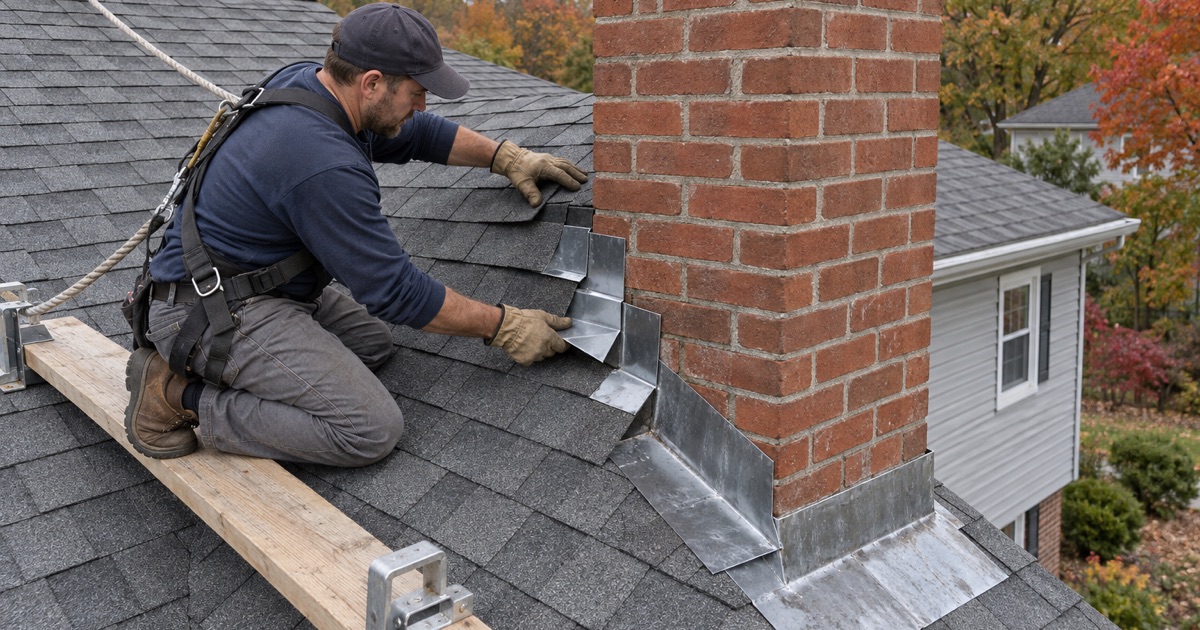
Step and Counter Flashing
Chimney flashing works in two layers. Step flashing is woven into each course of shingles along the sides of the chimney, and counter flashing is set into the mortar joints above it and lapped down over the step flashing. Together they let the roof and the chimney move without opening a gap.
When counter flashing pulls loose from the mortar, or step flashing has rusted or was never woven in, water runs behind it. We remove the shingles around the chimney, install new step flashing course by course, and cut new counter flashing into the mortar joints. This is a real repair, not a bead of sealant.
Counter Flashing Set in a Reglet
The top edge of the counter flashing should be bent into a groove cut into the mortar joint, called a reglet, and sealed there. Flashing that is simply surface-mounted with caulk along the top depends entirely on the caulk, which fails as it weathers. Cutting a proper reglet keeps water from getting behind the metal.
On older chimneys, we often find counter flashing that has been caulked and recaulked many times. We cut it out and install new flashing set into the joints. The result is a cleaner, longer-lasting seal.
Apron Flashing on the Downhill Side
On the downhill side of a chimney, an apron flashing laps over the shingles below and tucks up behind the counter flashing above. This piece takes the water that runs down the face of the chimney. If it is too short or poorly lapped, water gets under the shingles just below the chimney.
We replace the apron with the rest of the flashing so all the pieces work together. Each piece is lapped in the direction water flows. That simple rule, followed at every joint, is what keeps a chimney dry.
Crowns, Caps and Masonry
Cracked Chimney Crowns
The crown is the concrete or mortar slab on top of the chimney that sheds water away from the flue and the brick. Crowns crack over time from freeze and thaw, and water that gets into the cracks soaks the masonry below. A cracked crown can cause a leak that looks like a flashing problem.
Small cracks can sometimes be sealed with a product made for crowns. Badly cracked or crumbling crowns need to be rebuilt, ideally with an overhang that drips water clear of the brick. We assess which approach fits your chimney and explain why.
Chimney Caps
A cap covers the top of the flue to keep rain, snow, animals and debris out. A missing or damaged cap lets water fall straight down the flue, where it can rust a damper or soak the firebox. Caps also keep birds and squirrels from nesting in the flue.
We install or replace caps sized to the flue, fastened securely so wind does not lift them. On chimneys with more than one flue, a cap that covers the whole crown is often a better fit. A cap is one of the least expensive ways to keep water out of a chimney.
Repointing Mortar Joints
Mortar joints wear away over years of weather, especially on the side facing the prevailing wind. Open joints let water into the masonry, where it can travel down and show up inside. Joints that hold counter flashing also need to be sound for the flashing to stay put.
Repointing means grinding out the failing mortar to a set depth and packing in new mortar that matches the existing joints. We repoint the portion of the chimney above the roofline as part of chimney repair work. If the brick itself is breaking apart, we tell you plainly what that means.
Spalling Brick and Water Damage
When water soaks into brick and then freezes, the face of the brick can flake or pop off, which is called spalling. It is a sign that the chimney is taking on more water than it should. Left alone, spalling weakens the chimney over time.
We look for the cause, which is usually a cracked crown, missing cap or open joints, and fix that first. Badly damaged bricks may need to be replaced by a mason. Stopping the water is the step that keeps the damage from spreading.
Chimney Crickets
When a Cricket Is Needed
Water running down a roof hits the uphill side of a chimney and has to go somewhere. On a narrow chimney, it splits around easily. On a wide chimney, it can pool, along with leaves and snow, and work its way under the flashing.
A cricket, or saddle, is a small peaked roof built on the uphill side to divert water around the chimney. IRC R1003.20 calls for a cricket on chimneys wider than 30 inches. Many older chimneys wider than that were built without one, and they leak on the uphill side.
Building a Cricket During a Re-Roof
The best time to add a cricket is when the roof is being replaced, since the area behind the chimney is already open. We frame the cricket, sheath it, cover it with ice and water barrier, and flash it into the chimney and the roof. It is then shingled to match or covered in metal.
A cricket can also be added as a standalone repair on a roof that is not being replaced. It takes careful work to tie into the existing shingles. On a chimney that keeps leaking from behind, it is often the permanent answer.
Chimneys and a New Roof
Flashing Replaced With Every Roof
When we replace a roof, we always replace the chimney flashing instead of reusing it under the new shingles. Old flashing has been bent, nailed and sealed for years, and leaving it in place makes the chimney the oldest part of a new roof. That is where many new roofs leak.
New step, counter and apron flashing go in with the new shingles. If the crown or mortar needs work, it is easier to do while the roof is open. The scope lists flashing and chimney work as their own lines.
- 20+ Years in Business
- Attic Checked on Every Leak
- Itemized Written Scopes