Old Bridge Roofing brings more than 20 years in the trade to roofing in Highland Park, and a common reason a homeowner calls us is a leak that keeps coming back. Someone has already paid for a patch, maybe two, and the ceiling stain returns after the next heavy rain. At that point the question has shifted. It is no longer only where the water gets in, but whether to repair or replace.
We answer that in a fixed order. First we trace the leak from inside the attic as well as from the roof surface, because the spot where water drips is rarely the spot where it enters. Then we tell you plainly whether the roof can be repaired. Replacement only comes up after that answer, and only if the roof itself gives us a reason.
This page walks through how that decision works on a house, using a public example from the borough itself, and what to ask before a repair budget quietly turns into a replacement budget.
The Highland Park Library Roof: From $215,000 to $400,000
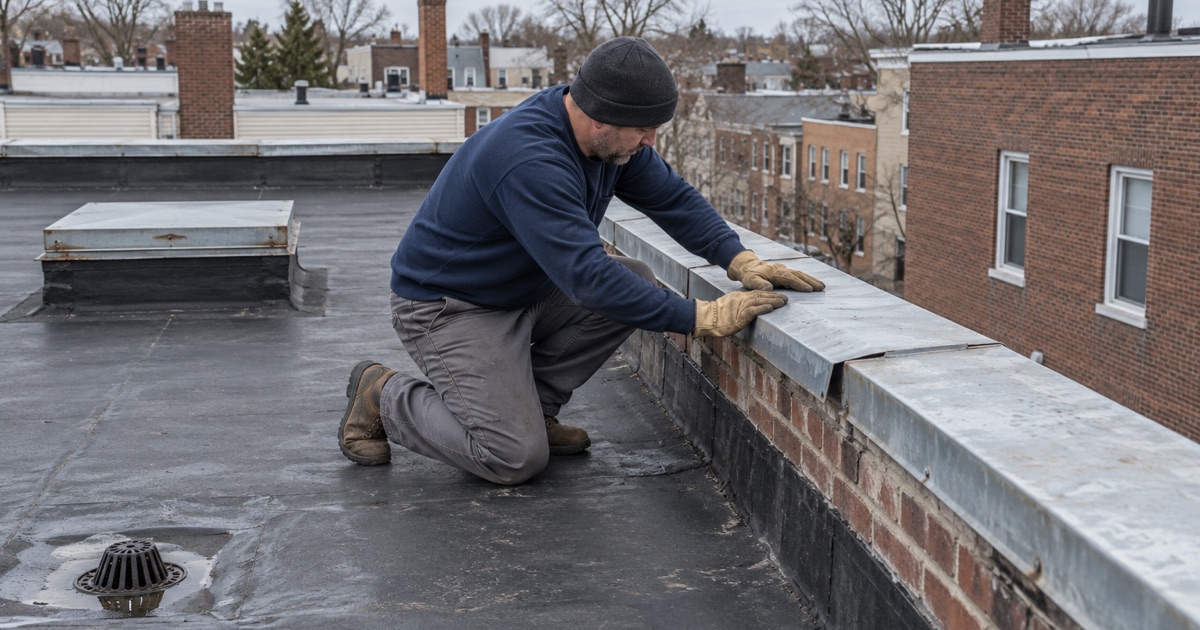
In 2023 the Borough of Highland Park dealt with the same problem many homeowners face, on a public building. Capital Ordinance 23-2075 set aside $215,000 for improvements to the public library roof to address persistent leaks. The work it described included, as needed, replacing a 3,000 square foot flat roof section.
Later that year the borough passed Bond Ordinance 23-2077, which appropriated $400,000 for replacement of the public library roof and related work, with about $380,000 authorized in bonds or notes. In the space of one year, the plan moved from fixing the leaking part of the roof to replacing the roof.
What the public record does and does not say
The two ordinances tell us the amounts and the sequence. They do not tell us why the borough changed course, who designed or bid the work, what the roof is made of, or whether it is finished. We had no part in the project, and we are not going to guess at the reasons behind it.
What the sequence does show is useful on its own. A leak-chasing budget was set first, and a full replacement budget followed. That order is familiar from houses, where a homeowner pays for one repair, then another, and only later prices the whole roof. The time to compare the two is before the repair money is spent, not after.
Why a public building is a fair comparison
A library is larger than a house, and the dollar figures do not scale down to a home roof. The shape of the decision does carry over, though. Persistent leaks, a defined problem section and a choice between fixing that section and replacing everything are the same three pieces we sort through on a residential call.
A homeowner rarely has a capital ordinance to read, but the same kind of record usually exists in a folder of invoices. Pulling those together, with dates and the area each repair covered, gives us a history of the leak that a single inspection cannot show on its own.
Looking for roofing closer to Metuchen? See Metuchen Roofing.
Persistent Leaks and the Flat Section Problem
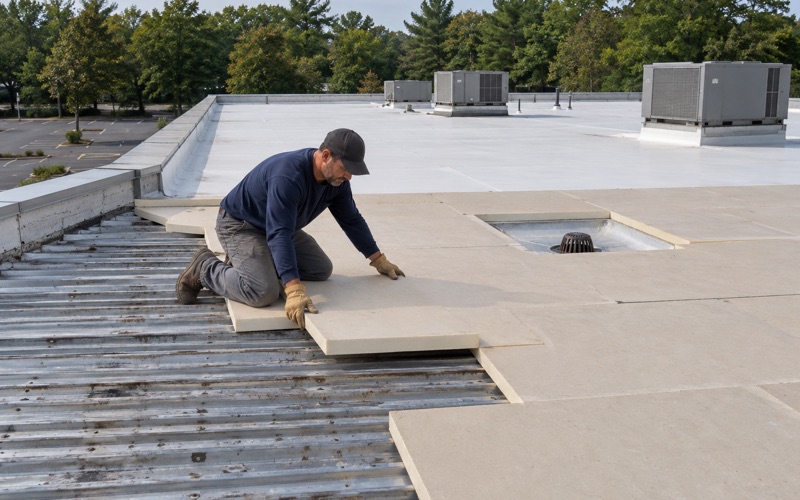
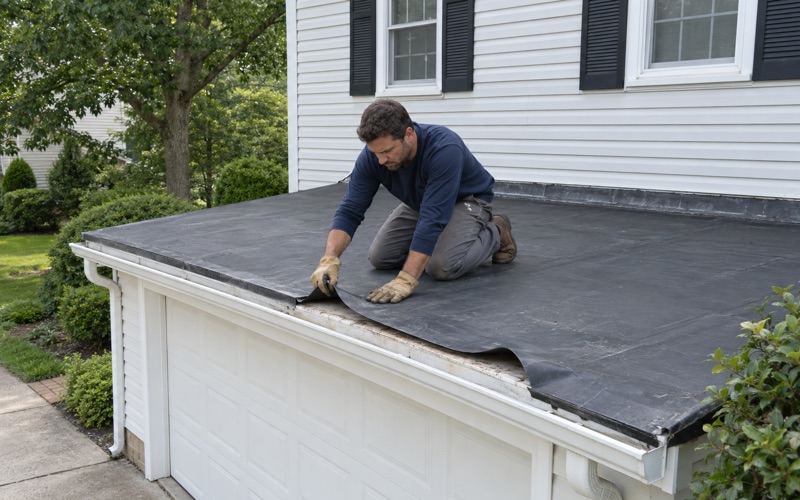
The library ordinance singled out a flat section, and that detail matters. A low-slope or flat roof sheds water slowly, so a small opening at a seam, a drain or a wall joint can let water sit and work its way in. When the same flat area leaks again and again, the trouble is often wider than the last patch.
Tracing the water before pricing anything
On a recurring leak we go into the attic or the ceiling space below the flat area as well as onto the roof. Stained sheathing, wet insulation and rusted nails show how far the water has traveled and how long it has been getting in. That inside view often explains why an earlier patch on the house gave out.
Ponding is another clue. Water that stands on a flat section for days after rain can point to sagging decking or a drain that cannot keep up, and patching the membrane will not change either one. We note where water collects and whether the deck under it has deflected.
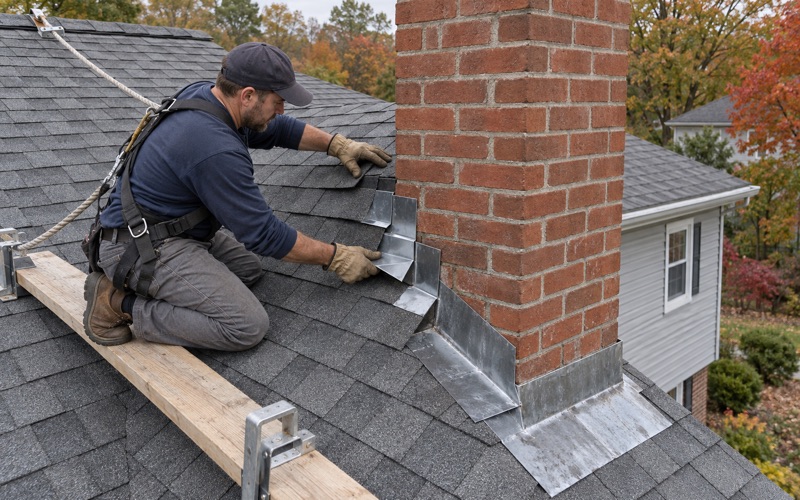
On the roof itself we look at the membrane or roll roofing, the seams, the edge metal and every place the flat section meets a wall or a pitched roof. Those junctions, where flashing has to turn a corner, are where many flat-roof leaks start. If the flashing is the cause, new membrane alone will not stop the water.
Repairing a section versus the whole roof
The library plan named a section by size, 3,000 square feet, rather than the whole roof. That is a sensible first step on any building: replace the part that is leaking and leave sound areas alone. It works when the rest of the roof still has years left and the failed area has clear edges.
On a house, a flat section replacement usually means removing the old covering down to the deck, replacing any soft decking, and installing a new membrane such as EPDM rubber, TPO or torch-down modified bitumen. When decking turns out to be damaged once the old layers are off, we photograph it and show you before it is replaced, at the per-sheet price already written into the contract.
When Patching Stops Making Sense: Pricing Repair Against Replacement
There is no fixed percentage that decides this, and we will not hand you one. What decides it is your own roof: how old the rest of it is, how many times the same area has been opened up, and what the next repair would actually involve compared with replacing the roof outright.
Signs a repair is still the right call
A repair makes sense when the leak traces to one clear cause, such as a cracked pipe boot, a lifted seam or a failed piece of step flashing, and the surrounding roofing is still sound. It also makes sense when the roof is relatively young and the problem area is small. In those cases we say so plainly and price the repair.
If you are selling the house, that answer can also go into a written roof condition report you can hand to the buyer’s inspector, so a sound roof with one repaired area is not mistaken for a roof that needs replacing.
Signs the money belongs in a replacement
The balance tips when patches keep landing on the same area, when water has reached the decking across a wide span, or when the remaining roof is near the end of its life anyway. Each new repair then buys a shorter stretch of dry ceiling, and the money spent on it does nothing for the replacement that is coming.
A simple exercise helps. Add up what you have already spent on repairs to that area, add the next quoted repair, and set the total beside a replacement price for the section or the whole roof. Seeing both numbers on one page is the comparison worth making before the next repair check is written.
Reading two estimates side by side
Our written scopes list tear-off, decking, underlayment, flashing, ventilation and gutters as separate lines. That lets you compare a repair quote against a replacement quote, or our number against another contractor’s, item by item rather than as two lump sums that hide what each one includes.
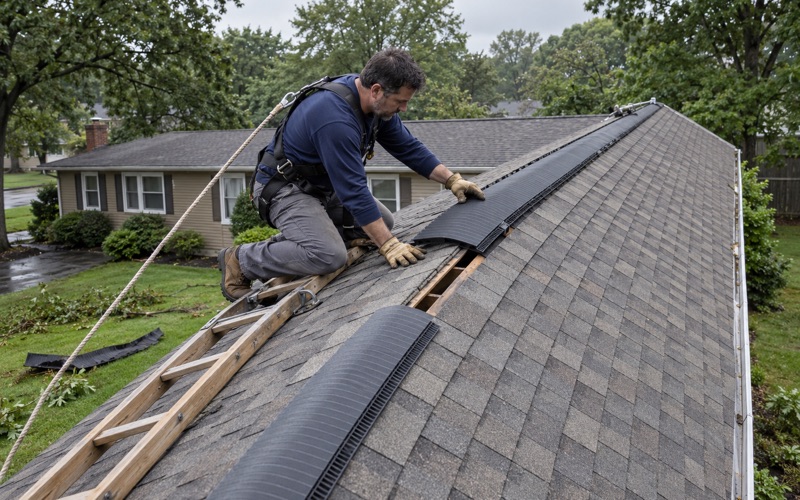
On a replacement, step, counter and chimney flashing is replaced with the roof rather than reused, and we check attic ventilation every time, since a roof that cannot breathe ages from underneath. Contracts follow New Jersey’s home improvement rules, including the three-day cancellation notice, so you have time to weigh the decision after signing.
Flat Sections on Highland Park Houses: Porches, Additions and Dormers
Highland Park sits on the northern bank of the Raritan River, and a good share of its housing is old: Census estimates show 27.4 percent of the borough’s housing units were built in 1939 or earlier. On older pitched-roof houses in general, the low-slope pieces tend to be a porch roof, a rear addition or the top of a shed dormer.
Those sections are small, so they are easy to overlook until a ceiling below shows a stain. They are also often where a sloped roof drains onto a nearly flat one, which puts more water across them than their size suggests.
Porch roofs and rear additions
A porch or addition roof usually ties into the main house at a wall, and that tie-in is the weak point. Water running down the siding needs counter flashing set into the wall above the roofing, and the corner where the porch roof ends needs a kick-out flashing so water does not run behind the trim.
Gutters belong in the same conversation. A porch roof that dumps water at the corner of the house, or a leader that empties beside the foundation, can undo a good repair, so we size and pitch gutters and leaders with the roof work.
When one of these sections leaks, we price it on its own first. If the main roof is sound, replacing only the porch or addition section with a new membrane and new wall flashing is often the right repair, and there is no reason to talk about the whole house.
Dormers and the timing question
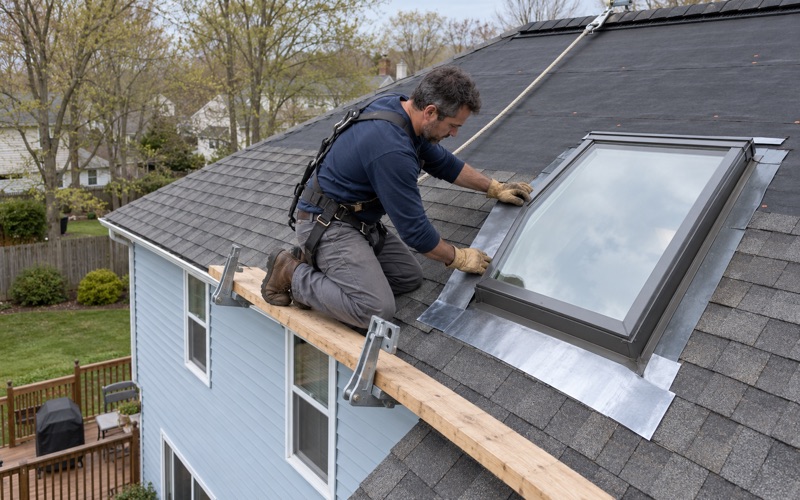
A shed dormer with a low-slope top is harder to treat in isolation, because the dormer walls and its top edge tie into the main shingle roof. If the main roof is close to replacement, it usually makes more sense to replace the dormer top in the same job so the flashing at every edge is new together.
For a detached one- or two-family house in New Jersey, replacing the roof covering is ordinary maintenance under N.J.A.C. 5:23-2.7, so a re-roof of this kind needs no construction permit. That keeps the decision where it belongs, on the condition of the roof and the numbers in front of you.
Whatever the answer turns out to be, we start in the attic and end with a written scope. If the honest answer is a repair, that is what we quote. At the end of each work day the driveway, yard and gutters are cleaned, with a magnet sweep for roofing nails.
- 20+ Years in Business
- Attic Checked on Every Leak
- Itemized Written Scopes