Old Bridge Roofing has spent more than 20 years on roofing in Manville and across central New Jersey, and the question we hear most after a big storm is not about shingles. It is about which deductible will apply to the roof. The answer is often not the one a storm’s name suggests, because it turns on how the storm was classified over New Jersey and on the exact wording of each homeowners policy.
Our part is the roof itself. We trace a leak from the attic side as well as from the shingles, tell you plainly whether a repair will hold before anyone mentions replacement, and write up storm damage with photographs you can use in your own claim. What your insurer pays, and under which deductible, is decided by your policy and your carrier, not by us.
This page walks through the storms Manville’s council has named on the record, the state rule that decides when a hurricane deductible can be used, and how to document roof damage so the claim you file rests on evidence rather than memory.
Four Storms on Manville’s Own Record

In Resolution #2024-80, adopted April 22, 2024, the Manville council wrote that storm severity in the region has increased, beginning with Tropical Storm Irene in 2011 followed by Hurricane Sandy in 2012, and more recently Tropical Storm Isaias in 2020 and Tropical Storm Ida in 2021. The resolution asks the State to take on regional flood projects for the Millstone River basin.
That list matters to a homeowner for a reason the council was not addressing. Every storm on it carried a name, and a name is exactly what leads people to assume a hurricane deductible applies to their roof claim. In New Jersey, the name alone does not decide it, and two of the four storms on that list prove the point.
Irene and Sandy, the first pair
Irene came through in 2011 and Sandy the following year. New Jersey took a formal position on each one, and in both cases the outcome for homeowners turned on how the storm was classified once it reached New Jersey rather than on the label it carried elsewhere along the coast. The next section covers both rulings in detail.
Isaias and Ida, the recent pair
Isaias in 2020 and Ida in 2021 appear in the resolution as tropical storms. We have not read any ruling from the New Jersey Department of Banking and Insurance on either one, so we do not tell owners whether a hurricane deductible was proper for those claims. If you filed after either storm, your declarations page and the carrier’s written explanation of the payment are the documents that settle it.
The broader habit is worth keeping. Whenever a claim letter cites a hurricane or named-storm deductible, ask the carrier which classification and which measurements it relied on, and ask for that answer in writing so you can compare it with the state rule below.
Looking for roofing closer to Roselle Park? See Roofing in Roselle Park.
How New Jersey Decides on a Hurricane Deductible
New Jersey’s rule sits in N.J.A.C. 11:2-42.7, and its Exhibit D sets a narrow trigger. A homeowners hurricane deductible applies only in the event of a hurricane named by the National Weather Service from which sustained hurricane-force winds of 74 miles per hour or greater have been measured in New Jersey by the National Weather Service.
The 74 mph test, read closely
Three conditions sit inside that sentence. The storm must be a hurricane named by the National Weather Service, it must produce sustained winds of 74 mph or more rather than a brief peak gust, and those winds must be measured in New Jersey. A storm that was a hurricane farther south but weakened on the way north does not meet the test on its name alone.
For Manville, the Weather Service office that forecasts for Somerset County is Mount Holly, and the borough falls in its forecast zone NJZ010. Because the rule is written around the Weather Service’s own measurements, those measurements, not a television map or a neighbor’s anemometer, are what the trigger is measured against.
Irene and DOBI Bulletin 11-16
Irene is the clearest example. In DOBI Bulletin No. 11-16, issued August 29, 2011, the Department of Banking and Insurance quoted the Exhibit D wording and stated that the National Weather Service did not report winds in New Jersey meeting all of the regulatory criteria. Under that bulletin, no hurricane deductible could be applied to Irene claims.
The lesson for a homeowner is that the regulation reads measured wind in New Jersey, not what a storm was called on its way up the coast. That is why the same storm can sound like a hurricane in the news and still fall outside the hurricane deductible in a New Jersey policy.
Sandy and Executive Order 107
Sandy reached the same result by a different route. The National Weather Service had reclassified Sandy as a post-tropical cyclone before it reached New Jersey, and Governor Christie’s Executive Order 107 made it a violation of N.J.A.C. 11:2-42.7 for an insurer to apply a hurricane deductible to Sandy claims.
Between them, Irene and Sandy show both halves of the rule at work: one storm did not meet the measured-wind test, and the other was no longer a hurricane by the time it reached the state. Neither result predicts the next storm, which is why the classification is worth checking every time a claim is opened.
Wind on the Roof, Water in the House
Manville’s resolution is about flooding, and the Raritan River and its tributary the Millstone meet in the borough’s far northeastern corner. That geography puts flooding at the front of any storm conversation here, but it can blur two kinds of loss that are insured in very different ways.
Flood coverage and roof claims are separate
Flood insurance does not cover wind or rain damage to a roof. Shingles torn loose by high wind, or rain driven in under lifted flashing, are raised under the homeowners policy, while rising water in a basement or living space belongs to flood coverage. Whether either policy pays, and how much, depends on its own terms.
We keep our notes the same way. After a storm, our write-up covers the roof, the attic and the drainage, and it records what we saw rather than guessing at the cause of water damage inside the house. That keeps the roof record clean for whichever claim it ends up supporting.
Older houses and the wear-or-storm question
Much of Manville’s housing is older. About 60 percent of homes were built between 1940 and 1969, and nearly a quarter of units sit in two-unit buildings. On an older roof, an adjuster may weigh whether damage came from the storm or from years of wear, and that is where evidence gathered promptly carries the most weight.
On a two-family house, a stain in one unit can trace back to an opening above the other, so we check the whole roof and the full attic rather than only the area over the complaint. That gives the owner one record for the building instead of two partial ones.
Re-roofing after a storm
If the roof needs replacing, New Jersey treats roof-covering replacement on a detached one- or two-family house as ordinary maintenance under N.J.A.C. 5:23-2.7, with no permit, inspection or notice to the building department required. Where an older roof already carries two or more layers, the rehabilitation subcode calls for tearing off to the deck before new material goes on.
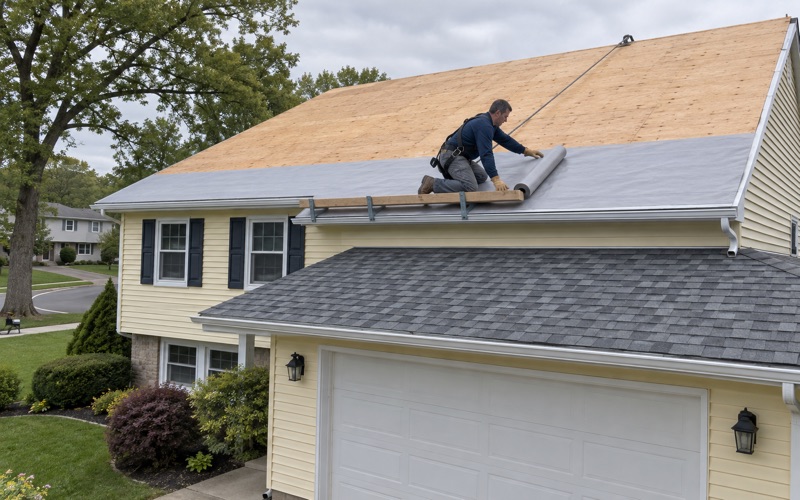
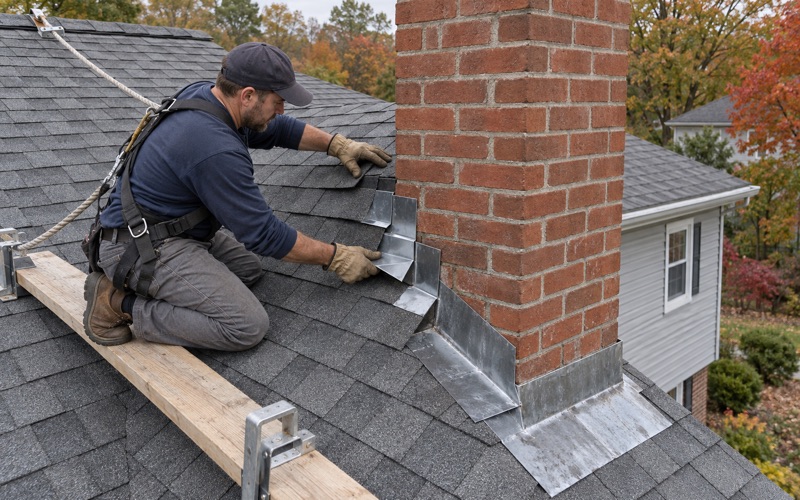
On a replacement we install new step, counter and chimney flashing rather than reusing the old metal, and we check that the attic can ventilate through soffit intake and ridge exhaust. A roof that cannot breathe ages from underneath, however good the shingles on top.
Documenting Roof Damage After a Named Storm
Whatever deductible ends up applying, a roof claim is only as strong as its record. The best time to build that record is in the first days after the storm, before tarps, further rain and a few weeks of memory change what anyone can show an adjuster.
Photos from the roof and from the attic
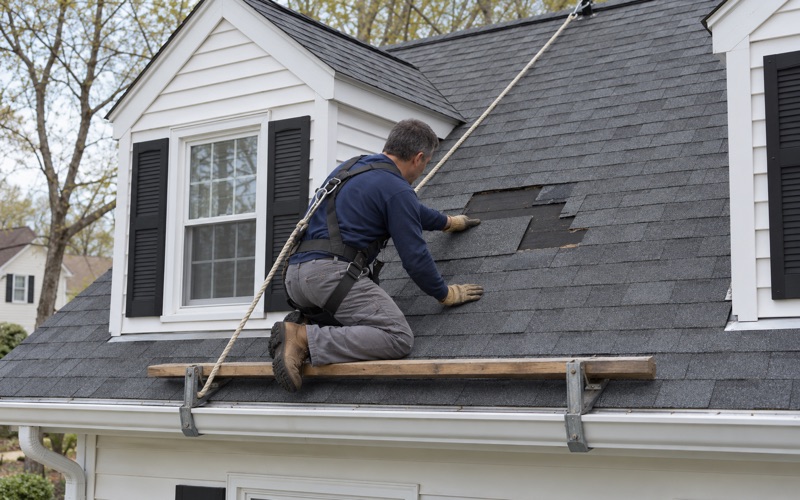
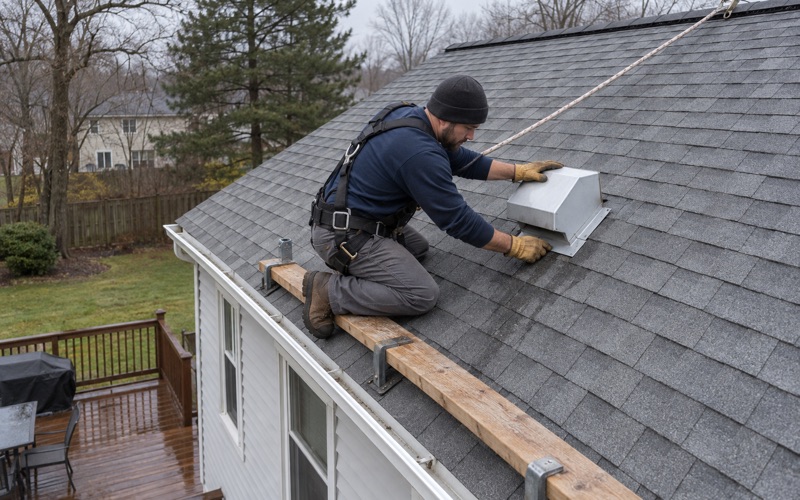
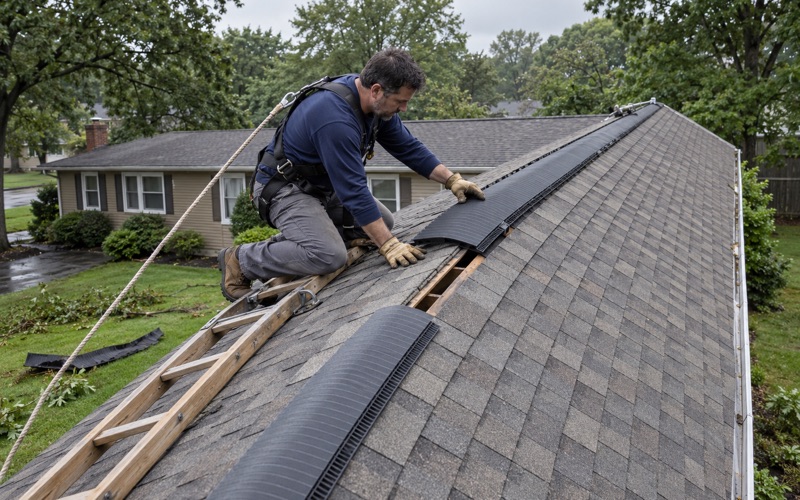
On every storm call we photograph the roof from outside and look into the attic from inside, so a ceiling stain is tied to the opening that let the water in. We record missing or creased shingles, lifted step and counter flashing, split pipe boots and gaps at the drip edge, and label each photo by slope and location.
The attic photos often matter most. Wet sheathing, daylight through the deck and water tracks along the rafters show where water entered in a way a description written weeks later cannot. Where we find damage that looks like long-term wear rather than a storm, we say so in the write-up too.
A written scope you can compare
Our estimate separates tear-off, decking, underlayment, flashing, ventilation and gutters into their own lines. That lets you set it beside an adjuster’s figures or another contractor’s bid and see exactly where the numbers differ. If damaged decking turns up once the old roof is off, we photograph it and show you before replacing it at the per-sheet price written into the contract.
The adjuster visit and your claim
The claim is yours to file and manage. New Jersey’s Public Adjusters’ Licensing Act, N.J.S.A. 17:22B, reserves negotiating a claim on an insured’s behalf to licensed public adjusters, so we do not negotiate with your carrier. When you ask, we will meet the adjuster on site, point out the damage we documented and answer questions about the roof.
If the work goes ahead, the contract follows New Jersey’s home improvement rules, including written notice of your three-business-day right to cancel. That window gives you time to set the scope beside your claim paperwork before any material is ordered, and to ask us about any line that does not match.
After the next named storm in Manville, start with the roof and the attic, then read the deductible section of your policy against the state rule. A clear record of what the wind did, and a carrier’s written answer on how the storm was classified, will tell you far more than the storm’s name ever will.
- 20+ Years in Business
- Attic Checked on Every Leak
- Itemized Written Scopes