
Old Bridge Roofing installs metal roofing in Old Bridge, NJ, serving surrounding cities including South River, Aberdeen, South Amboy, Holmdel and Highland Park, and our more than 20 years on local roofs shape how we detail every panel. Metal is a long-term roof, and how it is flashed and fastened decides whether it lives up to that. We focus on the details that matter most: underlayment, seams, edges and the places metal meets shingles or walls.
Some owners choose a full standing seam roof, while many more use metal on a porch, a bay window or a low-pitch addition and keep shingles on the main roof. Both are good uses of the material. We help you decide where metal earns its higher price and where shingles make more sense.
Every quote is itemized, with tear-off, decking, underlayment, panels, flashing and trim listed separately. That makes it easy to compare a metal quote with a shingle quote for the same roof.
Standing Seam Metal Roofs
Concealed-Fastener Panels
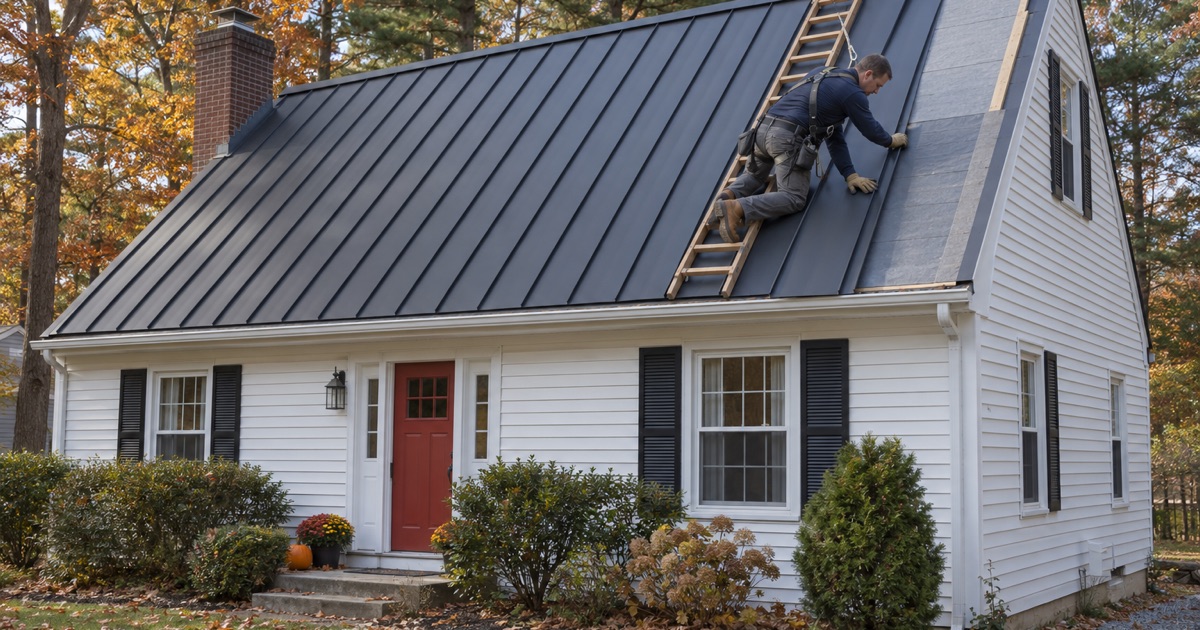
Standing seam panels run continuously from eave to ridge, joined by raised seams that stand above the flat of the roof. The fasteners are hidden under those seams, attached with clips to the deck. With no exposed screws, there are no rubber washers to dry out and no holes facing the weather.
That is the main difference from exposed-fastener panels, which are screwed through the face and depend on washers that age. Exposed-fastener metal has its place on sheds and agricultural buildings. On a house, concealed-fastener standing seam is the system we recommend.
Seam Types and Panel Profiles
Standing seam comes with snap-lock seams that click together and mechanically seamed panels that are folded closed with a seaming tool. Mechanically seamed panels hold up better on lower slopes and in wind, while snap-lock works well on steeper residential roofs. Panel width and seam height also affect the look.
We match the seam type to the slope and exposure of each roof and confirm it against the panel manufacturer’s requirements. Color and finish are chosen to suit the house and trim. Samples help, because the same color reads differently on a wide flat panel than on a small chip.
Underlayment and Expansion
Metal expands and contracts with temperature more than shingles do, so the panels have to move without tearing at fasteners or seams. Clips allow that movement, and the underlayment beneath needs to tolerate the heat that builds up under metal in summer. A high-temperature synthetic underlayment is the usual choice.
At the eaves and in valleys, ASTM D1970 self-adhering ice and water barrier adds protection. We check the deck for flatness before installing, since a wavy deck shows through flat metal panels. These steps are not visible on the finished roof, but they are what make it last.
Metal on Porches, Bays and Additions
Porch and Bay Window Roofs
A small metal roof over a front porch or bay window adds a clean accent to a shingled house and holds up well on shallow pitches. These small roofs are often where leaks start on older homes, because the flashing where they meet the main wall has aged. Replacing the covering is a chance to fix that detail.
We install step and counter flashing or a reglet into the wall above, so water is turned out rather than behind the siding. Where a porch roof meets brick, the counter flashing is set into the mortar joint. The result looks sharp and keeps water out at the joint that usually fails.
Low-Pitch Additions
Additions and enclosed porches often have roofs too flat for shingles to shed water reliably. Standing seam panels with the right seam type can work on lower slopes than shingles allow. That makes metal a strong choice where a membrane would look out of place on a visible roof.
We check the actual slope before recommending metal, because each panel system has a minimum. Where a roof is truly flat, a membrane such as modified bitumen, EPDM or TPO is still the right answer. We tell you which one fits rather than forcing metal onto a roof it does not suit.
Metal Next to Shingles
Most metal accent roofs sit beside or below a shingled main roof. The transition between the two needs careful flashing, so water from the shingles flows onto the metal and not under it. Where a metal roof meets a shingled slope above, the shingles lap over a flashing that covers the top of the panels.
Getting this right is the difference between a clean accent and a recurring leak at the joint. We plan these transitions before ordering materials. When a whole roof is being replaced, we coordinate shingle and metal work so they are flashed together.
Living With a Metal Roof
Snow Release and Snow Guards
Metal sheds snow well, but it tends to let go in sheets once the bottom layer starts to melt. Over front steps, walkways, decks or lower roofs, a sliding sheet of snow and ice can hurt someone or damage what it lands on. Snow guards fastened to the panels hold the snow in place until it melts gradually.
We plan snow guard placement over entries and lower roofs and attach them in ways that do not puncture the panels. On a porch roof over a front door, they are usually worth adding. On a roof that drops into an open yard, they may not be needed.
Rain Noise and Attic Comfort
Many people expect a metal roof to be loud. Over a solid deck with underlayment and an insulated attic, rain on metal is usually not much louder inside than rain on shingles. The drumming people remember comes from metal fastened over open framing.
On a porch with an open, exposed ceiling, you will hear the rain more, and some owners like that. Metal also reflects more summer heat than dark shingles, depending on color and finish. Attic ventilation still needs to be balanced under a metal roof, just as with shingles.
Bayfront Exposure in Laurence Harbor
Houses near Raritan Bay in Laurence Harbor see more wind and more salt in the air than homes inland. That affects how metal is detailed. Edge trim and clips need secure fastening, and the panel finish and fasteners should be chosen for coastal exposure.
On bayfront houses, we also plan staging and material handling for the wind off the bay, keeping panels secured and limiting how much roof is open at once. Metal handles wind well when it is fastened right. The details at the edges are where that is decided.
- 20+ Years in Business
- Attic Checked on Every Leak
- Itemized Written Scopes