Old Bridge Roofing has handled roofing in Middlesex and across central New Jersey for more than 20 years, and the question that matters after a summer storm is a simple one: did the roof come through? Hail is the reason that question deserves a real answer rather than a shrug, because the damage it leaves on shingles rarely shows up as a drip the same evening.
This page is about that question. We cover how close severe hail has come to the borough on the record, what stones about an inch across do to an asphalt roof, how a roof gets checked from the ground and the gutters first, and how impact ratings and insurance fit together. Throughout, we give a straight answer on repair before anyone talks about replacement.
Every leak or storm call we take includes a look in the attic as well as on the roof. Water and impact damage are traced to where they actually are before a single line gets priced, so the estimate you receive describes your house rather than a guess about it.
Severe Hail Near Middlesex: April and September 2023
Quarter-size hail on Interstate 287
On April 15, 2023, at 2:05 p.m., quarter-size hail was reported on Interstate 287 two miles south-southeast of Middlesex. The Storm Prediction Center logged the stones at 1.00 inch across. That point sits outside the borough line, so it is a report near Middlesex rather than in it, but two miles is a short distance for a moving thunderstorm cell.
The size matters. The National Weather Service calls a thunderstorm severe when it can produce hail an inch or larger or wind gusts over 58 mph. A quarter-size stone sits exactly on that line, so the April report met severe criteria by the agency’s own definition, on a stretch of highway a short drive from Middlesex homes.
The September 9, 2023 warning
On September 9, 2023, the National Weather Service office in Mount Holly issued a severe weather statement at 3:39 p.m. for Somerset and Middlesex counties. It described a storm moving north at 10 mph, carrying ping pong ball size hail up to 1.50 inches and 60 mph wind gusts, and it listed the borough of Middlesex among the places in its path.
The same statement noted that the storm had a history of producing hail up to golf ball size near New Brunswick, and the storm reports from that afternoon include a 1.75-inch stone there. Quarter-size reports came from several other points nearby. None of the reports that day came from inside the borough itself.
A warning is a forecast, not a damage report
It is worth being precise about what the September product was. A warning tells people a storm capable of that hail is headed their way; it is not an observation that hail fell on a given street. We found no record of hail damage to a Middlesex roof from either 2023 storm, and we will not tell anyone their roof was hit when the record does not say so.
What the record does show is that severe hail came close twice in 2023. Middlesex sits in National Weather Service forecast zone NJZ012, and borough police relay severe thunderstorm warnings through Nixle. When one of those alerts names the borough, the sensible response afterward is a calm look at the roof, not a ladder.
Looking for roofing closer to Eatontown? See Roofing in Eatontown.
What One-Inch Hail Does to an Asphalt Shingle Roof
Bruises and loose granules
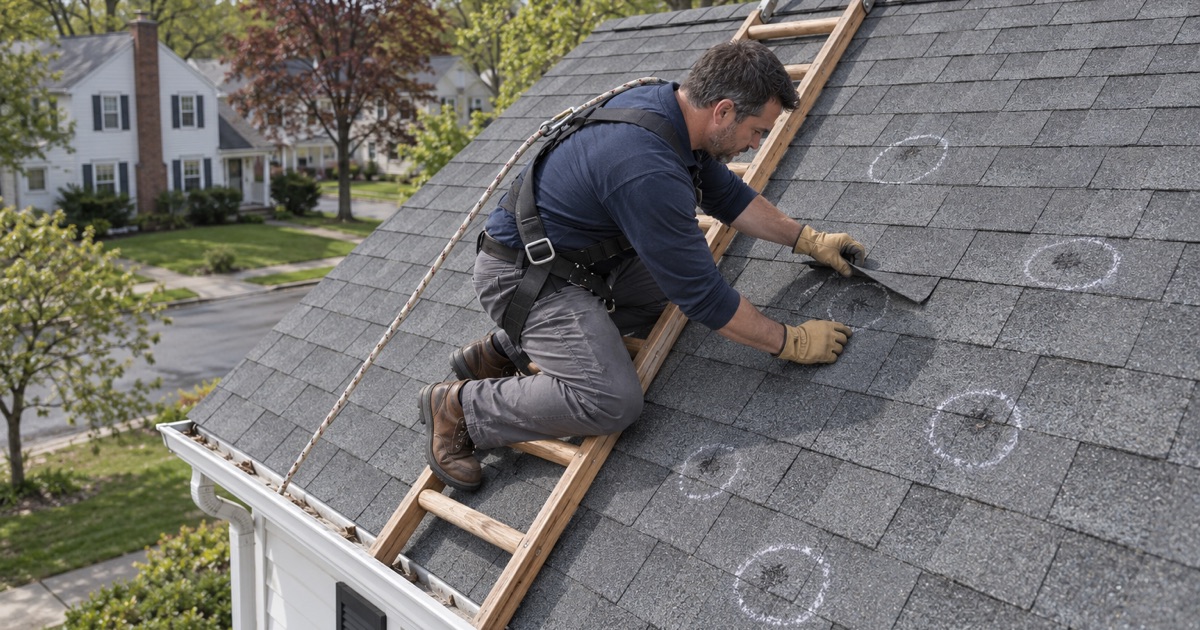
An asphalt shingle is a fiberglass mat saturated with asphalt and topped with mineral granules. When a hailstone around an inch across strikes it, the usual result is not a hole. The stone knocks granules loose and can leave a soft spot, often called a bruise, where the mat underneath has been crushed or fractured even though the surface still looks mostly intact.
Granules are the shingle’s sunscreen. Once they are gone from a spot, the asphalt beneath is exposed to ultraviolet light and weathers faster than the shingle around it. That is why hail damage tends to age a roof early rather than end it outright, and why a roof that came through a storm without a leak can still have lost years of service.
Why a struck roof rarely leaks the same day
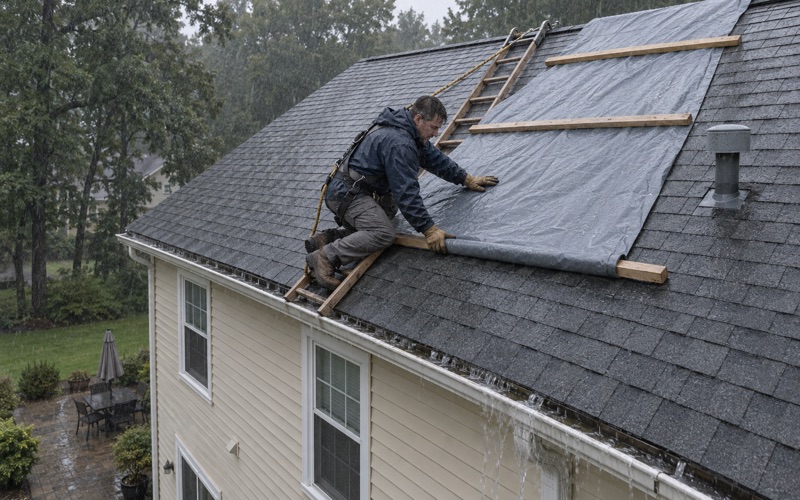
A bruised shingle still sheds water at first. The fractured mat may hold for a season or two before the spot cracks or erodes through, and by then the storm that caused it is long forgotten. Owners who wait for a ceiling stain to decide whether hail did anything are often looking at the problem a year or more after it started.
Wind adds a second layer to the same storms. The September warning paired its hail with 60 mph gusts, and gusts like that can lift shingle tabs and break the seal strip that holds them flat. A lifted tab that reseals poorly lets wind-driven rain work underneath, which is a different repair from a bruise and worth separating on any write-up.
Metal shows it before shingles do
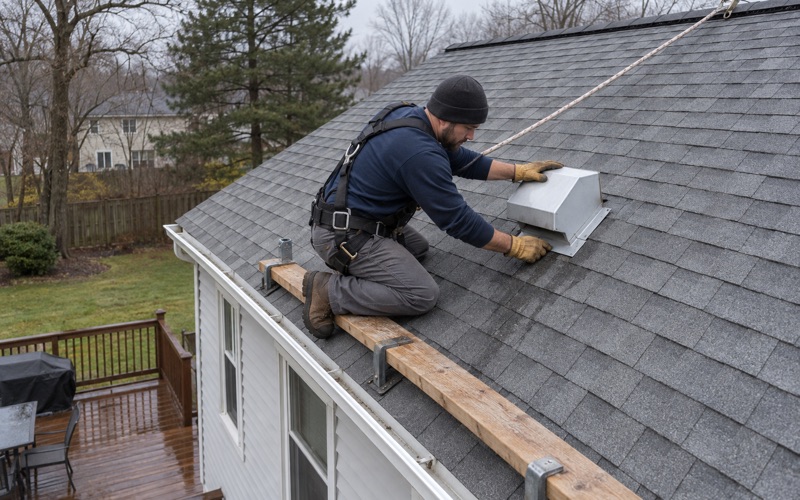
Soft metal is the easiest place to read a hailstorm. Aluminum gutters, downspouts, drip edge, roof vents and the caps on plumbing vents dent where shingles only bruise, and the dents stay put. A row of round dimples along a gutter face, or a vent cap peppered with marks, tells us roughly how large the stones were and which direction they came from.
Checking a Roof After Hail Without Climbing It
Start at the ground and the gutters
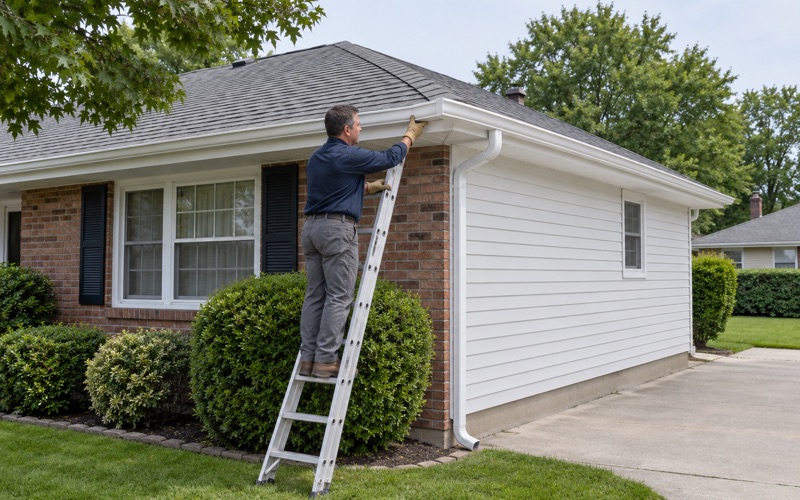
After a storm like the ones in 2023, the first check needs no ladder at all. Walk the house and look at the gutters, downspouts and any metal on the roof you can see from the yard. Look at the splash blocks and the ground under the downspouts, too, because a heavy rinse of granules there right after a storm is one of the clearer signs.
Note dented siding, window screens, a car hood or a mailbox while you are outside. Those are not roof problems, but they confirm that hail of real size fell on your lot rather than a mile away. A dated phone photo of each dent is worth taking that same day, since it pins the damage to the storm.
Leave the roof itself to someone equipped to be on it. OSHA’s fall protection rule for residential roofing applies at 6 feet, which tells you how seriously the risk is taken, and a wet, granule-covered slope after a storm is no place for an owner without harnesses or anchors.
What we look at on the roof and in the attic
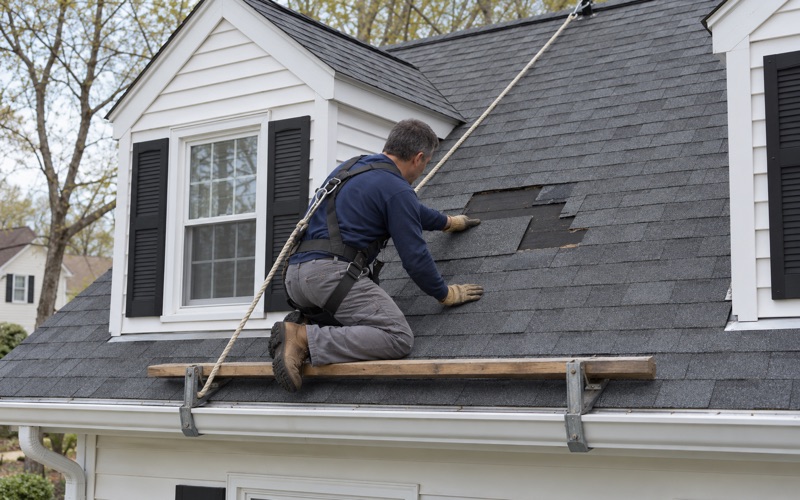
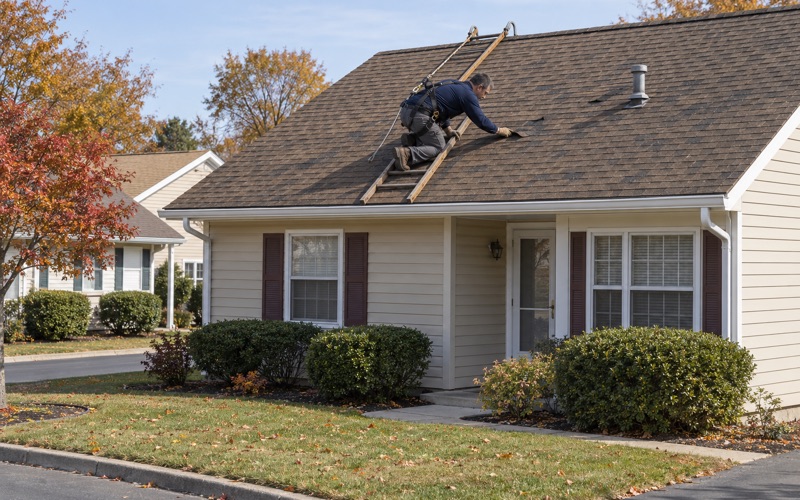
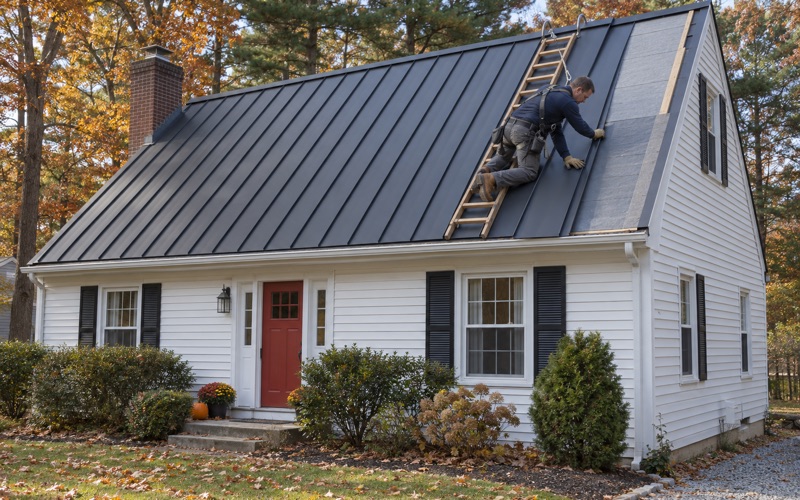
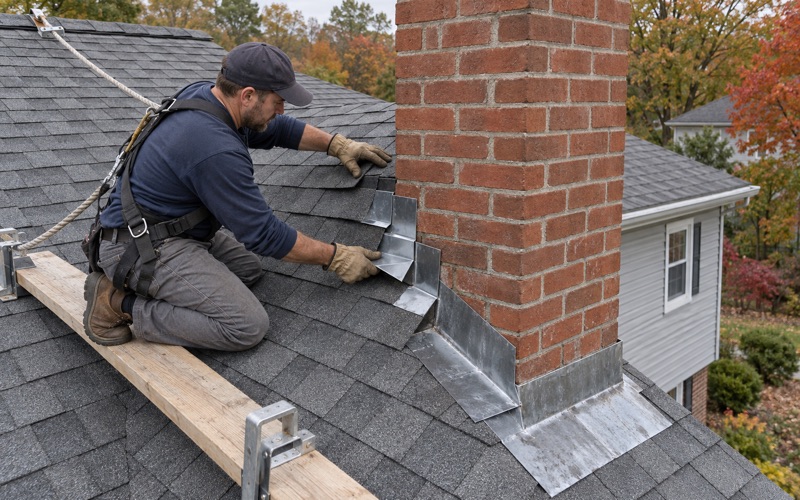
When we go up, we mark hits in a test square on each slope, check the ridge cap and the shingles around vents and pipe boots, and run a hand over suspect spots to feel for the give of a bruise. Each slope is photographed, because hail often favors the side facing the storm and spares the others.
The attic gets the same attention. From inside we look for daylight around nail penetrations, fresh staining on the decking and wet insulation below any lifted tabs. That second look tells us whether water has already found a way in, so the write-up describes where the roof is actually compromised rather than where it merely looks rough.
Repair answered before replacement
A few bruised shingles on one slope are a repair, and we say so plainly before replacement comes up. Widespread bruising across several slopes, broken mats and heavy granule loss are a different conversation, because patching a roof that has lost much of its protection only delays the replacement it already needs.
If replacement is the honest answer, the owner of a detached one- or two-family house should know that New Jersey treats a roof-covering replacement on that home as ordinary maintenance under N.J.A.C. 5:23-2.7, with no permit, inspection or notice required. Attached units and larger buildings are a different matter and go through the construction office at 1200 Mountain Avenue.
Hail, Impact Ratings and What Insurance Looks At
What a Class 4 rating does and does not mean
Shingles tested under UL 2218 are rated by how they hold up when steel balls are dropped on them, and Class 4 is the top rating. Impact-resistant lines are a reasonable choice for an owner replacing a roof in an area where severe hail has come close, and some insurers price that rating into the premium.
What the rating does not do is make a roof hail-proof. A Class 4 shingle can still be marked by large stones, and at least one manufacturer, IKO, states that hail damage is not covered under its limited warranty and that the rating exists for insurance premium purposes. We explain that before anyone pays extra for the label.
Photographs for your own claim
If a storm did mark the roof, we photograph the damage slope by slope and write it up so the owner can file their own claim with their insurer. When asked, our crew will meet the insurance adjuster on site to walk the roof and point out what the photographs show. The claim itself stays the owner’s.
That line is deliberate. In New Jersey, acting for a policyholder in negotiating a claim is public adjuster work under N.J.S.A. 17:22B, and a roofer is not one. The state Department of Banking and Insurance publishes storm claim guidance for homeowners, and it is a sensible first read before calling the carrier after a hail warning.
A scope you can compare line by line
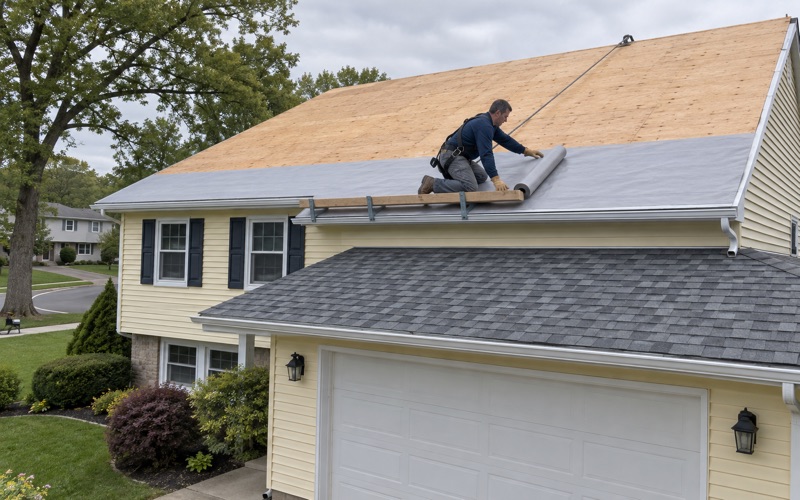
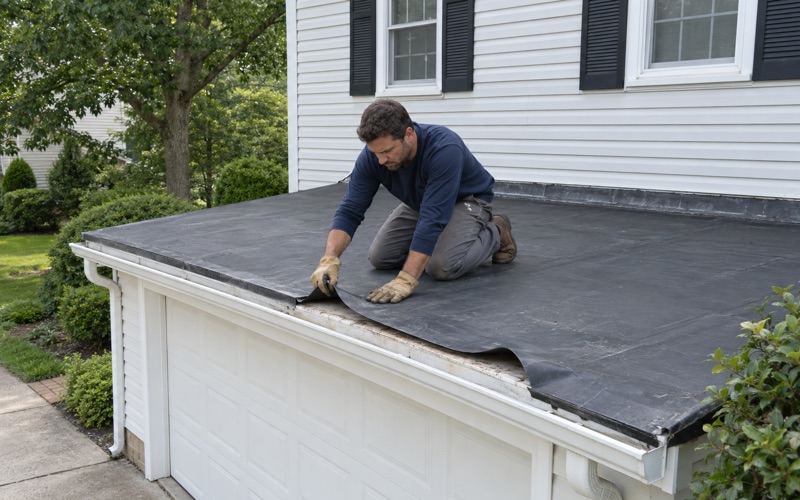
Whether the work is paid by a claim or out of pocket, our written scope breaks out tear-off, decking, underlayment, flashing, ventilation and gutters as separate lines. That lets an owner hold two estimates side by side and see exactly where they differ, which matters most after a storm, when several contractors may be quoting the same house.
Decking that turns out to be damaged once the old shingles are off is photographed and shown to the owner before it is replaced, at a per-sheet price already set in the contract. That contract follows New Jersey’s home improvement rules, including the three-day cancellation notice, so a decision signed in the rush after a storm can still be reconsidered within that window.
- 20+ Years in Business
- Attic Checked on Every Leak
- Itemized Written Scopes