Old Bridge Roofing brings more than 20 years in the trade to roofing in New Providence, and the question we hear most often about a winter re-roof here is a simple one: should the new roof carry a membrane up from the gutter edge, or not? This page answers it with numbers rather than habit, so the decision stays yours and rests on a record you can check.
Every leak call we take starts in the attic as well as on the shingles, because meltwater from an ice dam and water from a failed flashing can stain the same ceiling. We trace the path to where it actually enters before anything is priced, and we tell you plainly whether a repair will do before replacement comes up at all.
When a full replacement is the right call, our written scope breaks tear-off, decking, underlayment, flashing, ventilation and gutters into separate lines. That matters on this page in particular, because the eave membrane is its own line item, and you should be able to see what it adds before you agree to it.
Snow on New Providence Roofs, by the Station Record
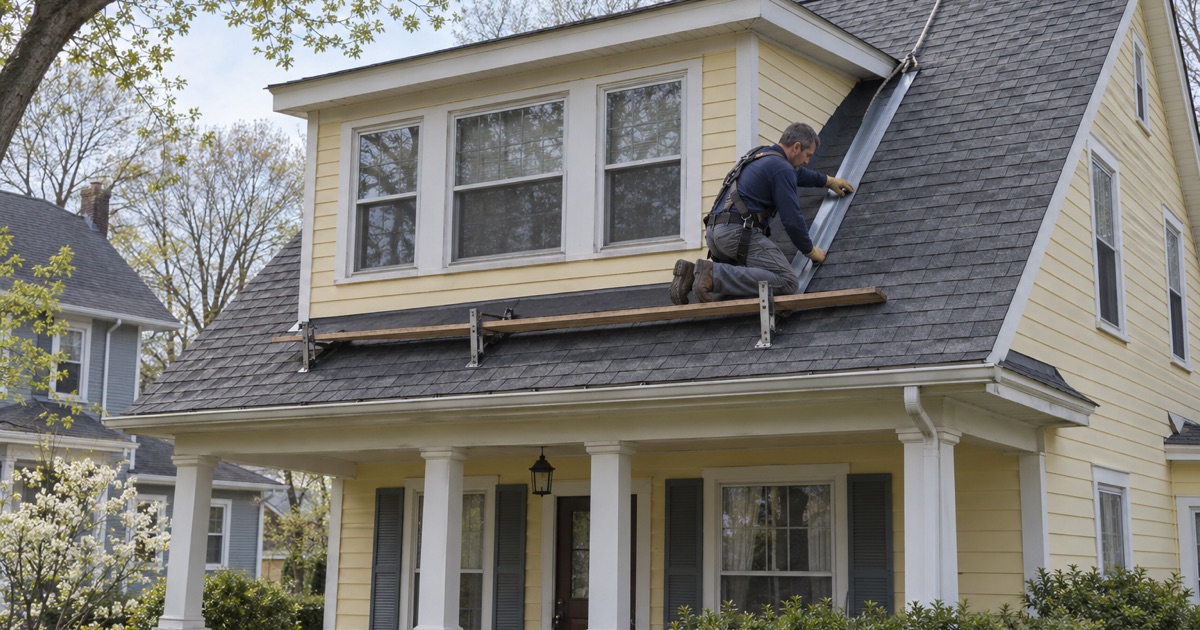
The snow figures we work from for New Providence come from Canoe Brook, a NOAA station outside the borough, about 4 miles northeast of borough hall on Elkwood Avenue. Its 1991-2020 normals are the nearest long-term record we have for this corner of Union County, and we cite them as a neighbor’s station, never as a measurement taken in town.
What the Canoe Brook Normals Say
Canoe Brook averages 24.0 inches of snow a year. More useful for a roof is how long it stays: the station logs 24.3 days a year with an inch or more on the ground and 11.3 days with 5 inches or more. January brings 5.8 inches of snowfall on average and February 8.4, so February outpaces January in that record.
Those are station figures, not a forecast and not a snow-load rating. We do not quote a pounds-per-square-foot number for New Providence roofs, because we have no measured figure to stand behind. What the normals do tell us is that snow is a regular season here rather than a rare event, measured in weeks of cover.
Read together, the station numbers describe roughly three and a half weeks a year with snow on the ground and about a week and a half with a real covering of 5 inches or more. Those are averages across thirty winters, so a single year can land well above or below them, which is exactly why a membrane decision is worth making on the record rather than on last winter’s memory.
Why Temperature Matters as Much as Snowfall
The station’s January mean is 30.7 degrees and its February mean is 32.4. Averages that hover near freezing are what make snow on a roof troublesome: days warm enough to melt a little, nights cold enough to refreeze it. A roof that sees weeks of cover under those swings gives meltwater plenty of chances to move where it should not.
For day-to-day planning, the borough falls in National Weather Service forecast zone NJZ107, Western Union, issued by the New York office in Upton. That zone forecast, not the long-term normals, is what we watch when a storm could land in the middle of a scheduled tear-off.
Looking for roofing closer to Chatham Township? See Chatham Township Roofing.
How Ice Dams Form at the Eaves, and Where Snow Sits Longest
An ice dam is a ridge of ice along the lower edge of a roof that holds back meltwater behind it. Shingles shed water running downhill well, but they are not built to hold a standing pool, and water backed up behind a dam can work under the tabs and through the nail holes into the soffit, the wall or the ceiling below.
Heat From the Attic Does the Melting
The usual cause is warmth leaking up from the living space. Heat that escapes into the attic warms the roof deck above it, the snow on that part of the roof melts from underneath, and the water runs down until it reaches the overhang. The overhang sits outside the heated walls, stays as cold as the air, and refreezes the water into a growing lip.
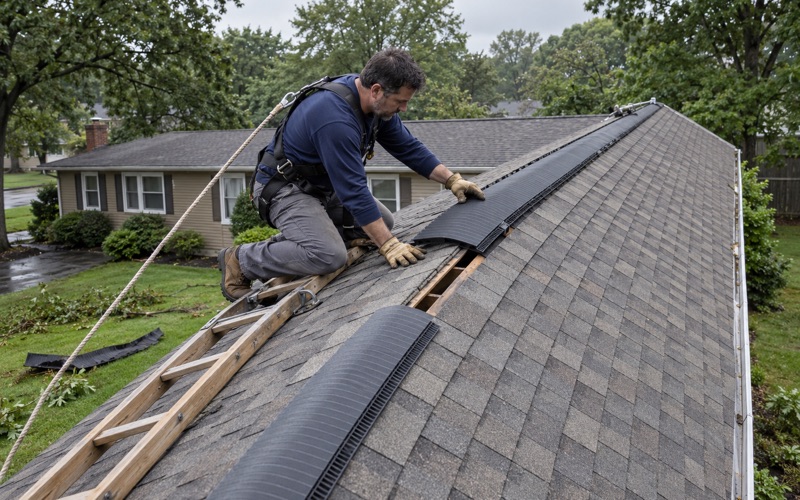
That is why we check attic ventilation on every replacement. A ridge vent paired with soffit intake, sized to the net free area the attic needs, keeps the underside of the deck closer to outdoor temperature. Ventilation and insulation will not stop every dam in a heavy year, but a roof that cannot breathe both melts more snow and ages faster from underneath.
When a ceiling stain shows up in February, we go into the attic before we go up the ladder. A wet patch directly inside an exterior wall points toward an eave backup; a stain farther in, under a valley or below a dormer, often points to flashing instead. Knowing which one it is decides whether the fix is a membrane conversation or a flashing repair.
Valleys, Dormers and Shaded Slopes
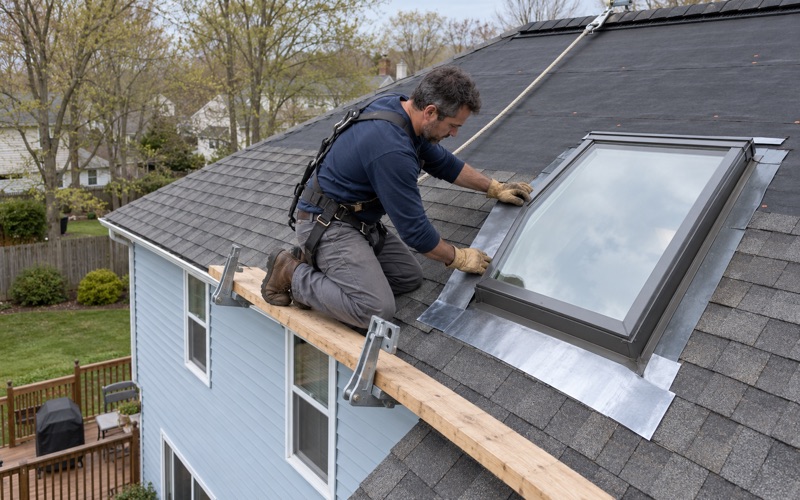
Snow does not leave a roof evenly. Valleys collect drift from two slopes at once and carry the most meltwater when it finally runs. The low corners where a dormer meets the main roof trap snow against the sidewall, right where step flashing and counter flashing do their work, and a north-facing slope can hold cover for days after the south side is bare.
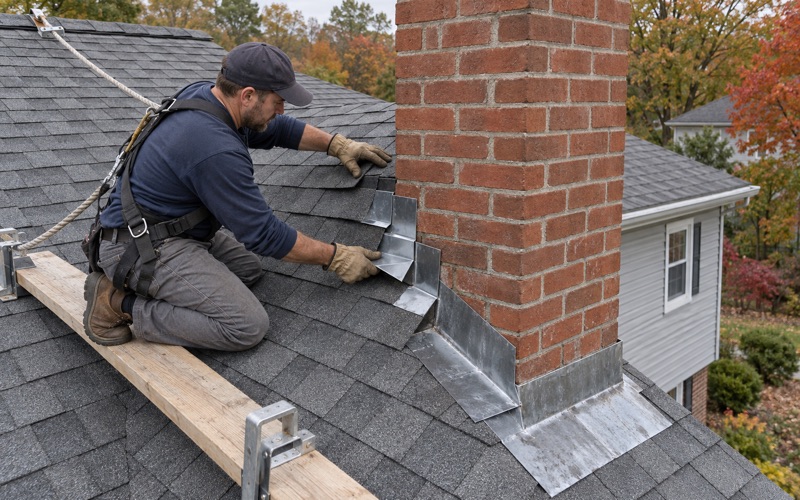
Behind a chimney the same thing happens on the uphill side, which is why a chimney wider than 30 inches calls for a cricket under the code to split the flow. We replace step, counter and chimney flashing with the roof rather than reusing old metal under new shingles, because these are the spots where a lingering snowbank finds a tired joint first.
The Ice Barrier Rule and the 25-Degree Line
The residential code has a specific rule for this problem. Under IRC R905.1.2, as New Jersey adopts it in N.J.A.C. 5:23-3.21(c), an ice barrier is called for at the eaves only where the average January temperature is 25 degrees or less. The barrier is a self-adhering membrane that seals around nails and holds back water that a shingle alone would let through.
Sussex County Is the Only Place the Trigger Applies
The Department of Community Affairs has said where that line falls. DCA Bulletin 07-3 identifies the area meeting the 25-degree condition as Sussex County, in the state’s northwest corner. Everywhere else in New Jersey, including New Providence and the rest of Union County, the code does not require an ice barrier at the eaves.
The Canoe Brook record shows why. A January mean of 30.7 degrees sits well above the 25-degree trigger, so a roof in this area is outside the rule even though it sees regular snow cover. The code answers the temperature question only; it says nothing about how many weeks of snow a particular roof carries.
Permits and Ordinary Maintenance
Replacing the roof covering on a detached one- or two-family house is ordinary maintenance under N.J.A.C. 5:23-2.7, needing no permit, inspection or notice. Work that affects structural or fire safety falls outside that rule. If tear-off turns up rotted decking, we photograph it and show you before a sheet is replaced, at the per-sheet price written into the contract.
If the house already carries two or more layers of roofing, New Jersey’s rehabilitation subcode, N.J.A.C. 5:23-6, calls for a tear-off before a new roof goes on. A tear-off is also the only time a self-adhering membrane can bond to bare decking, so the eave decision and the tear-off belong in the same conversation.
Our contracts are written to New Jersey’s home improvement rules, including the three-business-day cancellation notice, which leaves time to weigh the membrane line after you sign. If you decide on wider coverage during that window, we revise the written scope so the change is on paper before the crew arrives.
Choosing Eave Membrane on a New Providence Re-Roof
Because the code leaves it open, eave membrane on a re-roof in New Providence is a decision for the homeowner, and we treat it that way. We lay out what the station record says, what we found in the attic and at the overhangs, and what the membrane costs as its own line, then you choose. Nothing about it is buried inside an underlayment price.
What the Membrane Is
The product is a self-adhering ice and water barrier made to ASTM D1970. It bonds directly to the deck, seals around each fastener driven through it, and runs beneath the shingles along the eaves. The rest of the roof typically gets a synthetic underlayment made to ASTM D8257, which sheds water well but is mechanically fastened rather than sealed.
How Far Up From the Eaves
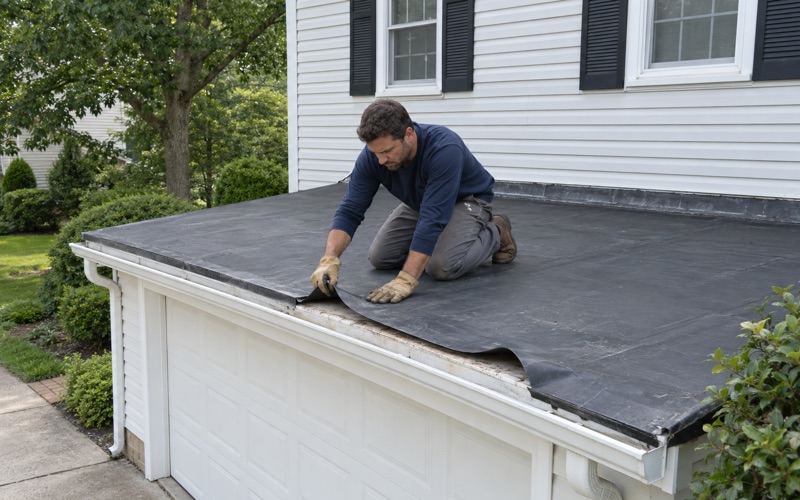
The question is less whether to use membrane than how far to run it. The code’s own measure, where it applies, is from the eave edge to a point at least 24 inches inside the exterior wall line. On a house with deep overhangs or a low-slope porch roof, that can mean two courses of membrane rather than one.
Some owners borrow that Sussex County measure as a sensible starting point and stop there. Others extend membrane into every valley, around the chimney and up the sidewalls of dormers, the places described above where snow lingers. A house with a history of ceiling stains along an outside wall usually justifies the wider coverage; a well-vented attic with clean eaves may not.
Gutters and the Edge of the Roof
Membrane handles water that gets under the shingles; gutters handle the water that does not. We size and pitch gutters and leaders with the roof so meltwater leaves the house instead of pooling at the foundation, and we keep drip edge continuous at the eaves and rakes so runoff clears the fascia. A gutter packed with ice is one more reason to settle the membrane question before the shingles go down.
New Providence covers about 3.71 square miles on the northwestern edge of Union County, with the Passaic River along its border with Chatham Township and Salt Brook winding through town. Across that small area, roofs face many directions and sit under varying shade, so the right eave detail is settled house by house, from what we see in the attic and on the slopes.
- 20+ Years in Business
- Attic Checked on Every Leak
- Itemized Written Scopes