Old Bridge Roofing has spent more than 20 years on roofing in North Arlington and across New Jersey, and the jobs we think hardest about here are the ones where a single roof keeps two households dry. A leak over a two-family house is never just a repair question. It is also a question of who lives under the wet ceiling and whose policy answers for what.
That is why every leak call starts in the attic as well as on the roof. We trace the water to the spot where it actually enters before anything gets priced, and we tell you plainly whether the roof can be repaired before replacement ever comes up. When the answer is a repair, the tenant and the owner both get their ceilings back sooner.
This page covers what changes when the roof is shared: how two-family houses fit into the borough, how the insurance split works after a leak, how we schedule around an occupied rental unit, and why gutters and flashing serving both units are treated as one system.
Two-Family Houses and the Two Households Under One Roof
How Common the Shared Roof Is Here
North Arlington is a borough of mixed housing. Census figures from the American Community Survey’s 2024 five-year estimates count 1,838 units, or 26.6 percent of the borough’s 6,900, in two-unit buildings. Another 35.6 percent are one-unit detached houses and 12.6 percent sit in buildings of three or four units. More than a quarter of the housing, in other words, shares a roof with exactly one other home.
The split inside those buildings matters more than the total. Of the occupied two-unit homes, 1,169 are rented and 568 are lived in by their owners. Those numbers point to two arrangements: an owner living in one unit and renting the other, or an owner living elsewhere with tenants in both. Either way, the roof belongs to one owner and sits over more than one household.
What a Shared Roof Changes for Us
On a single-family house we answer to one person. On a two-family house we usually answer to an owner who makes the decisions and a tenant who lives with the consequences, and they do not always hear about a leak at the same moment. We ask early who should get our findings, so photos and the written scope reach the person paying and the tenant hears what to expect.
The paperwork stays the same no matter how many households are involved. Our contracts follow New Jersey’s home improvement rules, including the three-business-day cancellation notice, and they are signed by the owner. Replacing the roof covering on a detached two-family house is treated by the state as ordinary maintenance under N.J.A.C. 5:23-2.7, the same as on a one-family house.
When the Tenant Spots the Leak First
The first person to see a stain is whoever lives closest to the problem, and on a rented two-family house that may well be the tenant. We are glad to take that call, but we will not schedule work or open the roof without the owner’s go-ahead. A quick three-way conversation at the start saves days of messages relayed back and forth.
Looking for roofing closer to South Orange Village? See Roofing Services in South Orange Village.
Whose Insurance Answers When a Shared Roof Leaks
A roof leak on a two-family house lands on two sets of belongings and, potentially, two different insurance policies. We do not sell insurance, interpret policies or handle claims, and we never tell anyone what their coverage will pay. What we can do is explain the general split New Jersey’s insurance regulator describes and give each household the documentation it needs.
The Landlord’s Policy and the Tenant’s Belongings
The New Jersey Department of Banking and Insurance put it directly in a March 19, 2015 release: a landlord will not cover property owned by a tenant in a rented apartment, house or condominium. The same release says renters insurance protects personal property against damage or loss. That guidance is about tenant belongings in general and does not mention roofs specifically.
For an owner who lives in one unit and rents the other, the practical point is simple. A wet sofa or ruined laptop in the rented unit is the tenant’s to take up with their own renters policy, if they carry one. The owner’s questions about the building itself go to the owner’s insurer. Both households should call their own agents early rather than assume the other side’s policy steps in.
Documentation Both Households Can Use
When a leak or storm is behind the call, we photograph the damage on the roof and in the attic and write it up for the owner’s own claim. If the owner asks, our crew will meet the insurance adjuster on site. We keep the description to what we saw and where the water got in, which is the part of the record a roofer can honestly supply.
A tenant may want the same facts for a renters claim. With the owner’s agreement, we can share the date of the inspection and the point of entry we traced, so the tenant is not guessing. Negotiating with any insurer is the work of a licensed public adjuster under New Jersey law, N.J.S.A. 17:22B, and it is not something we do.
Why Timing Matters to Both Claims
A slow leak that sits for weeks can turn a small ceiling stain into a larger repair for the owner and more damaged belongings for the tenant. That is why we try to get a temporary repair in place quickly once the source is found, then sort out the permanent fix. Prompt action also gives both households cleaner records of when the damage started.
Scheduling Roof Work Around the People Who Live Underneath
Replacing a roof over an occupied rental unit is a different job from replacing one over an empty house. Two households hear the tear-off, two sets of cars need moving, and two families need to know when the roof will be open. We build the schedule with the owner first and then make sure the tenant gets the same dates in writing.
Access to the Attic in a Rented Unit
Our leak inspections always include the attic, and on some two-family houses the attic hatch is reached through the tenant’s space. We ask the owner to arrange that access with proper notice rather than arriving at a tenant’s door unannounced. A short visit inside usually tells us more about where water enters than an hour on the shingles.
Tenants also deserve to know what we will not touch. We work on the roof, the attic and the exterior drainage, and we stay out of living spaces except for the attic access we arranged in advance. If interior ceiling repair is needed afterward, that is between the owner and whoever does the plaster work, and we say so plainly at the start.
Tear-Off Days and Weather Windows
We open only as much roof as we can dry in the same day, so neither unit sits under a bare deck overnight. If decking turns out to be damaged once the old roof comes off, we photograph it and show the owner before replacing it, at the per-sheet price written into the contract. The tenant does not have to wait while a surprise cost is argued over.
The National Weather Service assigns the borough to forecast zone NJZ104, Eastern Bergen, issued by its Upton, New York office. We watch that zone forecast when picking tear-off days, because a two-family roof opened before an afternoon storm puts two households at risk instead of one.
Keeping Both Units Livable
Driveways, yards and gutters are cleaned at the end of every work day, finished with a magnet sweep for roofing nails. On a shared lot that matters twice, because both households often use the same walk and driveway. We also tell both units which days will be loud and which will be quiet cleanup, so nobody plans a night-shift sleep around the wrong morning.
Gutters, Leaders and Flashing That Serve Both Units
A two-unit house usually has one drainage system, even when the people inside think of it as two homes. A clogged leader on one side can send water down a wall the other household lives behind. We size and pitch gutters and leaders together with the roof, so water leaves the house rather than settling against the foundation both units sit on.
Seamless Gutters Sized for the Whole Roof
Seamless aluminum gutters and leaders are our usual choice on a replacement, because fewer joints mean fewer places to drip onto an entry or a porch one household uses every day. Where a leader empties beside a shared driveway or walk, we look at where that water goes next. Gutters appear as their own line on the written scope, never folded into a lump sum.
At the eaves and in valleys we lay self-adhering ice and water barrier meeting ASTM D1970, with synthetic underlayment over the rest of the deck. Drip edge goes on at eaves and rakes so runoff clears the fascia and drops into the gutter, not behind it. On a shared house, that edge detail protects the siding and trim of both units.
Flashing Replaced, Not Reused
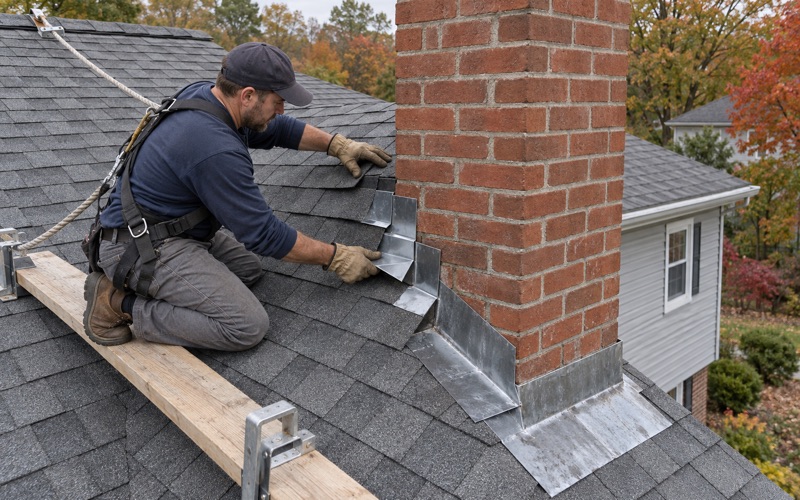
Step, counter and chimney flashing come off with the old roof and are replaced, not bent back into place under new shingles. On a two-family house a single chimney or party-wall junction may vent or border both units, so a flashing failure there can show up in either household’s ceiling. We also check apron and kick-out flashing where a lower roof meets a wall.
Ventilation and an Itemized Scope
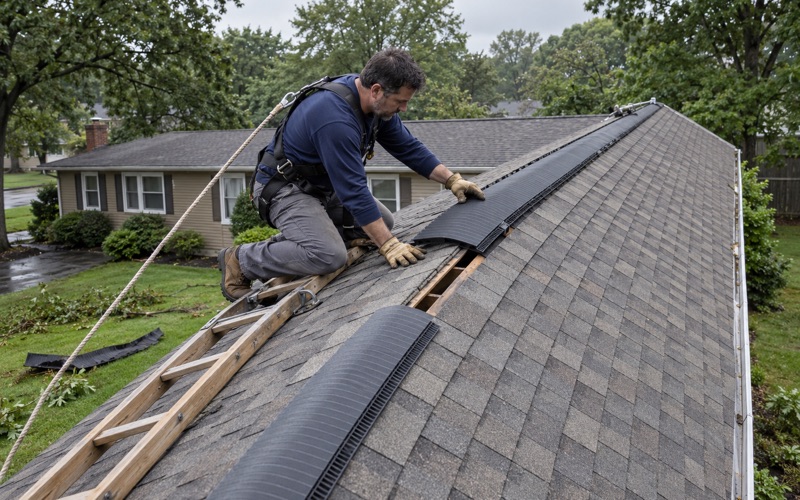
Attic ventilation gets checked on every replacement, since a roof that cannot breathe ages from underneath no matter whose unit sits below it. Our written scope lists tear-off, decking, underlayment, flashing, ventilation and gutters as separate lines. For an owner comparing bids while also keeping a tenant informed, that line-by-line format makes it easier to explain exactly what is being done and why.
Where Borough Questions Go
North Arlington is the southernmost municipality in Bergen County, set between the Passaic River and the Meadowlands. Its Construction Department sits at 214 Ridge Road, and because fees there depend on several variables, the office quotes them by phone or in person. An owner with a question about borough paperwork for a two-family house can call that office directly before work is booked.
- 20+ Years in Business
- Attic Checked on Every Leak
- Itemized Written Scopes