Old Bridge Roofing brings more than 20 years of experience to roofing in South Orange Village, and the first thing we give any homeowner is a straight answer on whether the roof can be repaired. Replacement is discussed only after that question is settled, because on an older house the repair answer is often the one that saves the most material worth keeping.
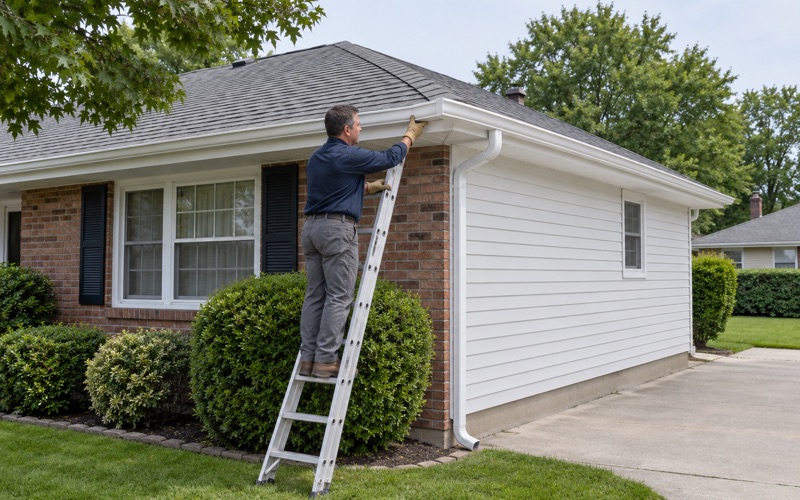
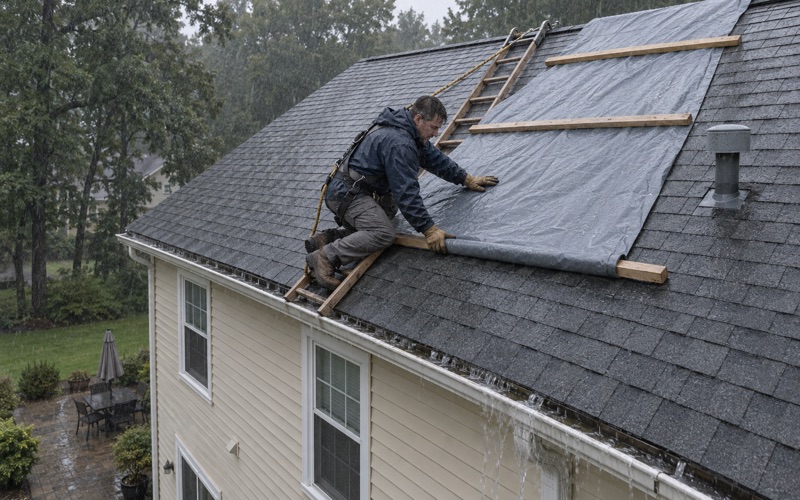
A leak call starts in the attic as well as on the roof. Water rarely shows up on a ceiling directly below the spot where it got in, so we follow the stain back along rafters and sheathing until we find the entry point, and only then do we price anything. That habit matters most on roofs where a misplaced ladder or a careless step can crack material that is hard to match.
Our written scopes break tear-off, decking, underlayment, flashing, ventilation and gutters into separate lines. If you are weighing our estimate against another, you can compare them item by item instead of trying to decode a single lump sum.
Slate and Tile on South Orange’s Revival-Era Houses
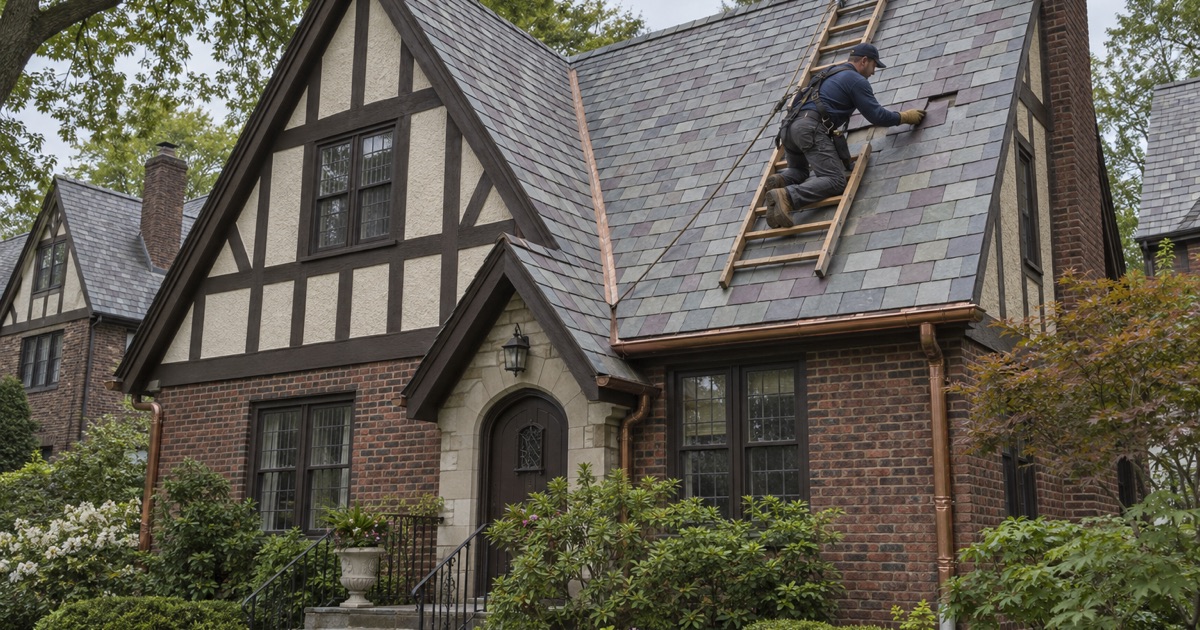
South Orange is a pre-war village by the numbers. The 2024 American Community Survey counts 2,701 of its 6,208 housing units as built in 1939 or earlier, which is 43.5 percent of the stock. Houses that age were roofed with whatever the builder and owner chose at the time, and on some of the more substantial ones that choice was slate or clay tile.
What the Montrose Park Nomination Records
The Montrose Park Historic District, listed on the National Register in 1997, covers about 406 acres in the northeast corner of the village. Its nomination, prepared by Ulana D. Zakalak, inventories house by house, and it shows that slate in South Orange was not only a Victorian material. Several of the slate-clad houses it describes were built between about 1900 and 1920, and three of them are brick Colonial Revivals.
On Centre Street, the nomination describes three brick Colonial Revivals from about 1920 at 319, 327 and 333, with slate-clad hipped, side-gable and clipped-gable roofs. On Berkeley Avenue it records a slate-clad side-gambrel house at 470, a slate-clad hipped-roof estate house at 555 built by Paul Starrett of the Thompson-Starrett Company, and an earlier slate-clad hipped roof at 565, dated to about 1900.
The Tudor Revival Slate Roof
The nomination names Tudor Revival as the predominant influence along Centre Street, Grove Road, Charlton Avenue and Irving Avenue. One example on Berkeley Avenue, dated to about 1930, is described as ‘all united by a polychromatic slate-clad roof,’ meaning slates of more than one color laid together across the whole roof.
A polychromatic roof is the hardest kind of slate repair to do invisibly. Replacement slates have to match in color, thickness and size, and the pattern of mixed colors has to continue across the patch. When we look at one, we note which colors are in the field before anything is removed, so a repair blends rather than reading as a square of new stone.
None of this means every older house in the village carries slate. A local broker guide calls composite a common substitute, and no count of slate or tile roofs exists. What the record does show is that a 1920s Colonial Revival or a 1930 Tudor Revival in South Orange may still be wearing its original stone.
Looking for roofing closer to Branchburg? See Branchburg Roofing.
Repair, Re-Lay or Replace: Reading an Old Slate Roof
A slate roof that is decades old is not automatically a roof at the end of its life. The stone itself is durable, as that broker guide also notes, and it is usually the fasteners, the flashing or a handful of broken pieces that start a leak. Our first job is to sort out which of those is actually failing on your roof.
When a Spot Repair Is Enough
Cracked, slipped or missing slates scattered across a sound field can be replaced one at a time. The broken piece is cut out, a matching slate is slid into place and secured, and the surrounding stone stays undisturbed. On a roof with a few isolated problems, this is the answer we give first, because it keeps the original material doing its job.
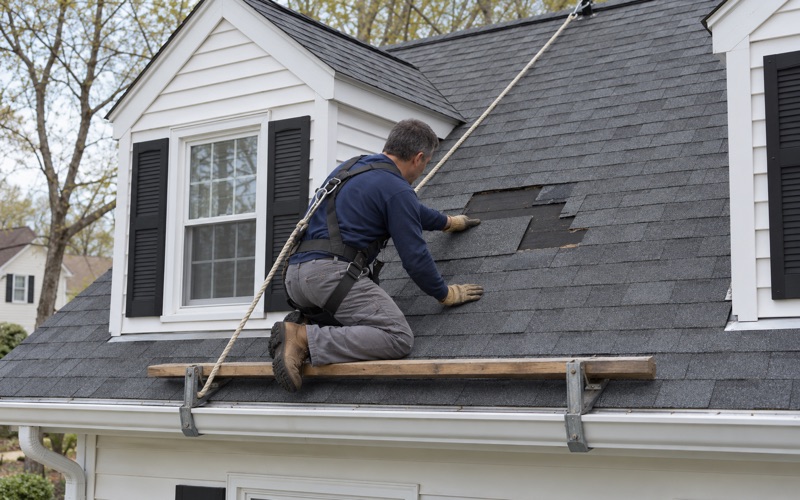
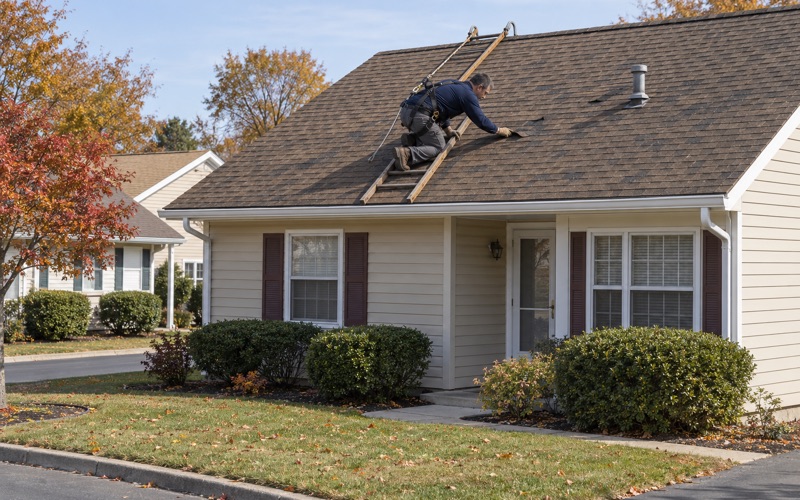
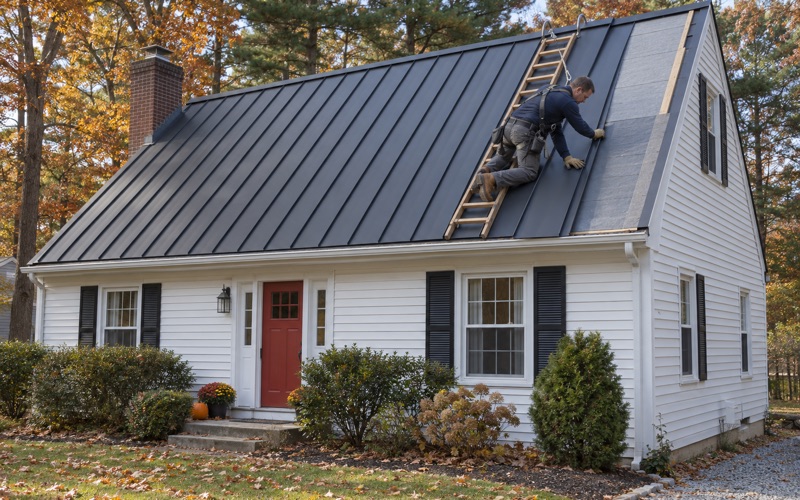
Getting onto a slate roof is itself part of the job. Slate cracks under a boot, so we work from ladders hooked over the ridge and roof brackets rather than walking the field, and OSHA’s fall protection rule for residential roofing at 6 feet applies throughout. A repair that breaks three slates to fix one is not a repair.
When Re-Laying Makes Sense
Sometimes the slate is sound but what holds it is not. Nails that have rusted through let pieces slide, and underlayment beneath an old roof can be long past its useful life. In that case the slates can be removed carefully, sorted and stacked, the deck and underlayment repaired, and the good stone laid back with new fasteners.
Re-laying is slower than replacing, and some pieces will break in handling, so the scope has to account for salvage losses and matching stock. If decking turns out to be damaged once the slate is up, we photograph it and show you before any board is replaced, at the per-sheet price written into the contract.
When Replacement Is the Honest Answer
When slates are delaminating, flaking or turning soft across large areas of the roof, spot work stops making sense. At that point we say so plainly and lay out what replacement would involve, including the tear-off requirement covered further down this page. You get the repair answer and the replacement answer in writing, with their reasoning, so the decision is yours.
Clay Pan Tile and Copper Flashing on Pre-War Houses
Slate is not the only heavy material the Montrose Park inventory records. On Centre Street it describes an Italian Renaissance house from about 1915 whose hipped central block had a green pan tile roof in 1997. Clay tile like that is shaped, fired and laid in overlapping courses, and it behaves very differently from slate when a piece breaks or a leak appears.
Repairing Pan Tile
Pan tile breaks under foot traffic and under falling limbs, and the replacement has to match the profile of the tiles around it, not just the color. We remove broken pieces without disturbing the course above and below, check the underlayment beneath for water staining, and set the new tile so it laps the way the original did.
As with slate, the attic tells us a lot. A tile roof can look intact from the street while water tracks along the deck underneath, so we check the sheathing from inside before deciding whether the problem is a few tiles or the layer beneath all of them.
Copper Flashing on Older Roofs
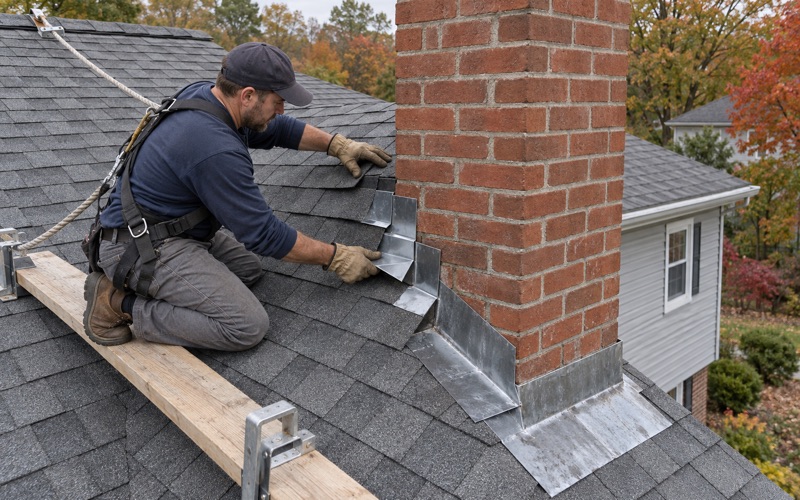
Pre-war slate and tile roofs were often detailed with copper at valleys, chimneys and walls. Copper lasts a long time, but solder joints open, nails work loose and counter flashing pulls out of mortar joints as chimneys age. Many leaks on roofs like these start at the metal rather than the stone, which is why we look there before blaming the slate.
When a roof is replaced, step, counter and chimney flashing is replaced with it rather than reused under the new material. On a re-laid slate roof, the work is the natural time to renew valley and chimney metal while it is exposed. Where a chimney is wider than 30 inches, the residential code calls for a cricket behind it to shed water around rather than against it.
Water After It Leaves the Roof
The East Branch of the Rahway River runs the length of the village and once flooded low-lying areas before Army Corps projects in the mid-1970s. Roof water is a smaller matter, but it still has to go somewhere, so gutters and leaders are sized and pitched with the roof to carry it away from the foundation.
Why Old Slate or Tile Comes Off Before a New Roof
New Jersey’s rehabilitation subcode limits a roof to two layers and requires existing slate, wood shake or tile to be torn off before a new covering goes on. Asphalt shingles cannot simply be laid over a slate or tile roof in South Orange, however tempting that shortcut looks on a price sheet.
Replacing the covering on a detached one- or two-family house is treated as ordinary maintenance under N.J.A.C. 5:23-2.7, but that classification does not change the tear-off rule. The old roof still has to come off down to the deck, and the deck has to be sound before anything new is fastened to it.
What Tear-Off Reveals
Slate and tile are heavy, and the boards beneath them on a house from the 1910s or 1920s have carried that weight for roughly a century. Once the old material is off, we can see whether the sheathing is solid, split or rotted around old leaks. Nothing new goes down until that question has an answer.
Board sheathing on older houses sometimes has gaps between boards that suited slate but do not suit shingles, which need a continuous surface. Where that is the case, the scope will say whether the plan is to overlay the boards with new sheathing or replace them, and it will show that as its own line.
Choosing What Goes On Next
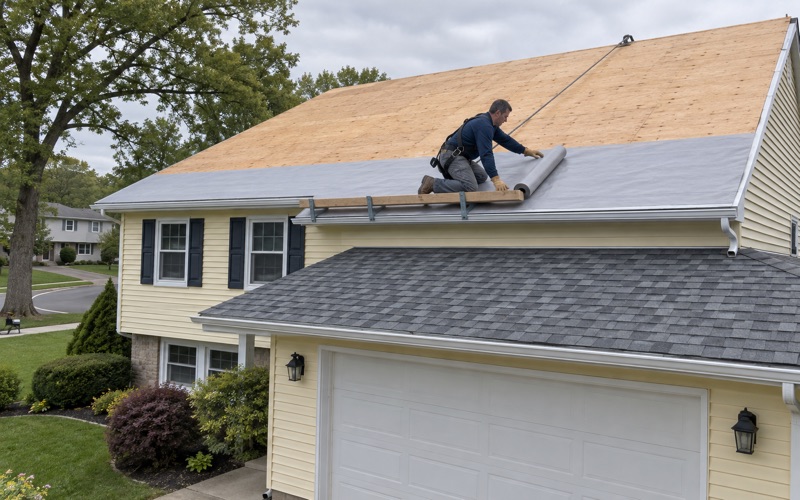
Once the deck is ready, the choice of new covering is yours. Some owners want slate again; others choose architectural shingles such as GAF Timberline HDZ or CertainTeed Landmark, which weigh far less. Either way, the new roof goes down over ASTM D1970 ice and water barrier at the eaves and valleys, with fresh drip edge and flashing.
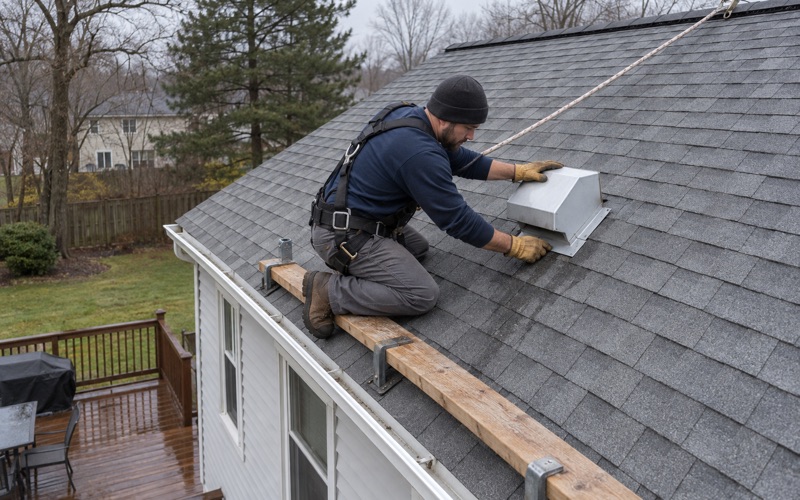
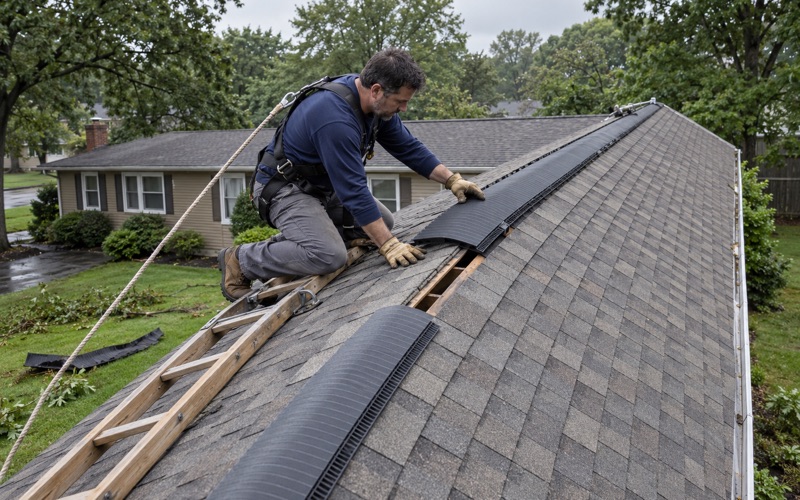
Attic ventilation gets checked on every replacement, because a roof over an attic that cannot breathe ages from underneath. On a pre-war house that can mean planning ridge vent and soffit intake that the original roof may never have had. Each work day ends with the driveway, yard and gutters cleaned and a magnet sweep for nails.
Contracts follow New Jersey’s home improvement rules, including the three-day cancellation notice. If you own a slate or tile house in South Orange and are not sure whether it needs a repair, a re-lay or a new roof, that is the first question we answer.
- 20+ Years in Business
- Attic Checked on Every Leak
- Itemized Written Scopes